


Cabinet pulls are functional hardware used to open cabinet doors and drawers while also shaping the overall look of cabinetry. Choosing the right pulls depends on cabinet style, size, finish, and mounting position. This guide explains the most popular cabinet pull styles, how to select the right size, and how to install them correctly for a balanced and practical result.
1. What Are Cabinet Pulls?
Cabinet pulls are handles attached to cabinet doors and drawers to make them easier to open and close. Most pulls use two mounting screws, while cabinet knobs typically use one mounting point.
Because they provide a wider grip, cabinet hardware pulls are commonly used on kitchen cabinets, bathroom vanities, closet systems, built-in storage, and commercial cabinetry.

Cabinet pulls are especially useful for:
- Wide drawers that need a comfortable grip
- Frequently used cabinet doors
- Modern and transitional cabinet designs
- Kitchens that require a consistent hardware style
The main difference between knobs and pulls is their shape and mounting system. Knobs are compact and generally use one screw, while pulls are longer and usually require two mounting holes.
Cabinet door pulls also have a stronger visual impact because their length, shape, and finish become part of the overall cabinet design. A small pull may look balanced on a narrow upper cabinet door but appear undersized on a large drawer.
For this reason, choosing cabinet pulls should consider three factors together: cabinet style, cabinet front size, and everyday usability.
2. What Are the Most Popular Types of Cabinet Pulls?
The most common cabinet pull styles include bar pulls, cup pulls, edge pulls, and minimalist modern pulls. Each option creates a different look and works better with certain cabinet designs.
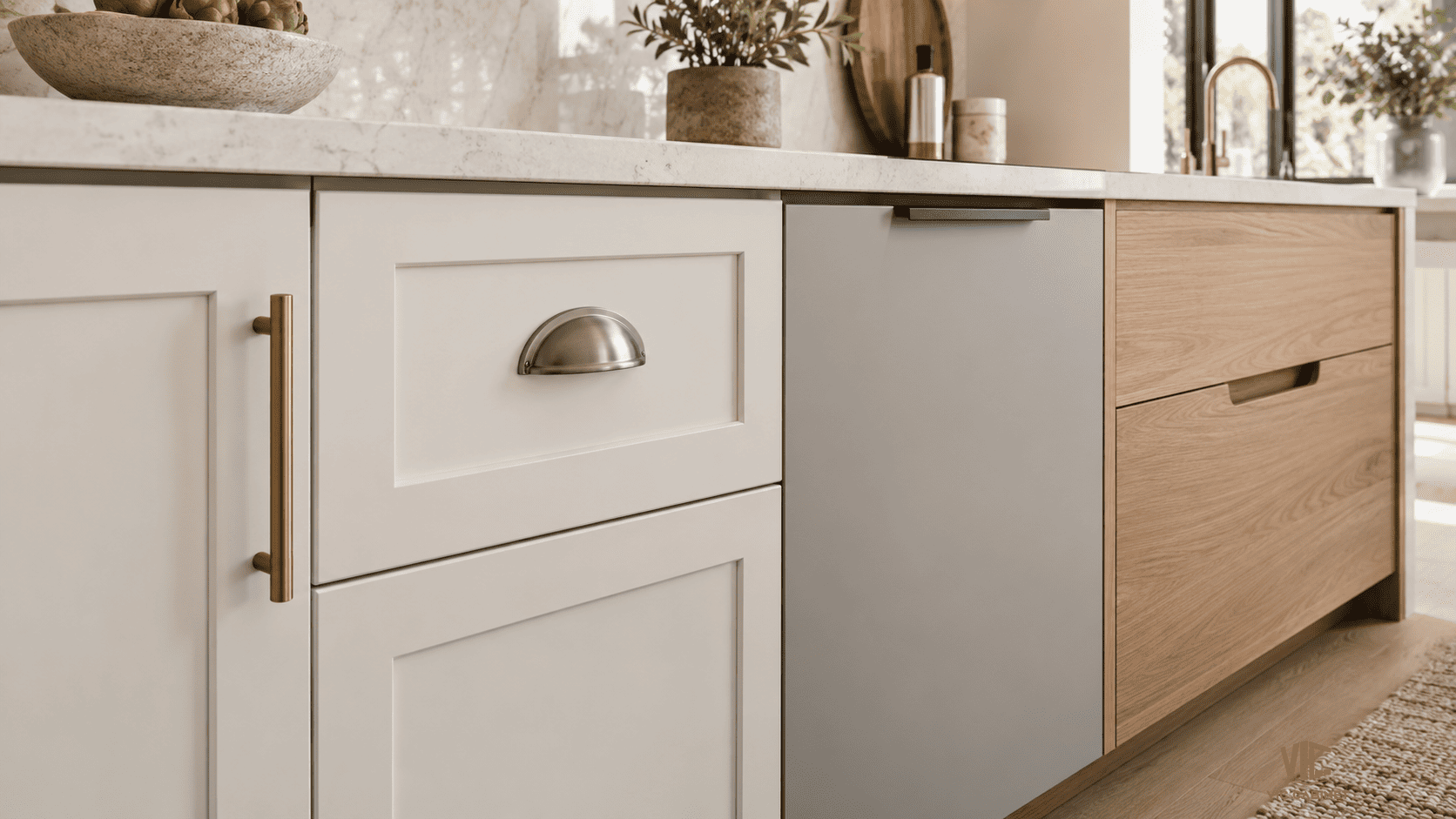
2.1. Bar Pulls
Bar pulls feature a straight and simple profile and are one of the most versatile options.
They work well with:
- Shaker cabinets
- Slim Shaker cabinets
- Flat-panel cabinets
- Transitional kitchens
Bar pulls are available in many lengths, making it easier to keep the same hardware style across doors and drawers of different sizes.
2.1. Cup Pulls
Cup pulls have a curved shape that users grip from underneath. They are most commonly installed on drawers rather than cabinet doors.
Their more decorative appearance makes them suitable for farmhouse, traditional, and transitional cabinetry.
2.3. Edge Pulls
Edge pulls are mounted along the top or side edge of a cabinet front instead of sitting prominently on the face.
They are commonly used with slab and flat-panel cabinets because they help maintain a clean and streamlined appearance.
2.4. Modern Cabinet Pulls
Modern cabinet pulls usually feature clean lines, slim profiles, and minimal decorative details.
Popular options include:
- Slim bar pulls
- Edge pulls
- Finger pulls
- Matte black pulls
- Brushed brass pulls
- Brushed nickel pulls
Matte black creates strong contrast against white, gray, and light wood cabinetry. Brushed brass adds warmth and pairs well with white cabinets and walnut finishes.
Brushed nickel offers a more neutral look and works well across both residential and commercial cabinet designs.
3. How Do You Choose the Right Cabinet Pulls?
The right cabinet pull should match the cabinet style, remain proportional to the door or drawer, and provide a comfortable grip.
A simple starting point is to match the pull design with the cabinet door style.
| Cabinet Style | Suitable Pull Style |
| Shaker | Bar pull or arch pull |
| Slim Shaker | Slim bar pull |
| Flat panel | Edge pull or finger pull |
| Inset | Bar pull or cup pull |
| Walnut or wood cabinet | Black, brass, or nickel bar pull |
The hardware finish should also coordinate with nearby elements such as faucets, lighting fixtures, appliances, countertops, and other metal finishes.

The first measurement to understand is center-to-center, often written as C-to-C.Center-to-center is the distance between the centers of the two mounting holes. It is different from the overall length of the pull. This measurement is especially important when replacing existing hardware because a new pull with a different hole spacing may require new drilling.
As a general guideline:
| Cabinet Front | Suggested Approach |
| Small door or drawer | Short pull |
| Standard cabinet door | Medium pull |
| 18–24 inch drawer | Medium to long pull |
| 24–30+ inch drawer | Longer pull or two pulls |
These are general design guidelines rather than strict rules. The final choice should depend on cabinet proportions, pull design, and the desired visual effect. Longer pulls usually look more balanced on wide drawers. On narrow cabinet doors, oversized pulls may make the cabinet front appear crowded.
For multifamily or large cabinet projects, standardizing a limited number of pull sizes can also simplify ordering, installation, inventory, and future replacement.
4. How Should Cabinet Pulls Be Mounted?
Mounting cabinet pulls correctly requires accurate measurements, consistent positioning, and checking alignment before drilling. A simple installation process includes the following steps.
Step 1. Confirm the Center-to-Center Measurement
Measure the distance between the two mounting holes on the pull before drilling. If replacing existing hardware, make sure the new pull matches the current hole spacing whenever possible.
Step 2. Determine the Pull Position
Decide exactly where the pull should be placed on each cabinet door or drawer. On paired cabinet doors, the hardware should be positioned symmetrically.
Step 3. Use a Cabinet Hardware Jig
A hardware jig or drilling template helps maintain the same mounting position across multiple cabinet fronts. This is especially useful when installing hardware across dozens or hundreds of cabinets.
Step 4. Check Alignment Before Drilling
Mark or temporarily position several pulls before drilling the first hole. Looking across the entire cabinet run can reveal alignment problems that may not be obvious on a single door.
Step 5. Drill and Install
Drill the mounting holes carefully and use screws with the correct length for the cabinet front. Avoid overtightening because it can damage the cabinet surface or hardware.
Common mistakes when mounting cabinet pulls include:
- Using the wrong center-to-center measurement
- Installing undersized pulls on wide drawers
- Positioning pulls too close to cabinet edges
- Using inconsistent mounting heights
- Drilling before checking door orientation
- Installing multiple pulls without a template
For RTA cabinet projects, pull specifications should ideally be confirmed before deciding whether cabinet fronts will be pre-drilled at the factory or drilled during installation.
5. Where Can You Buy Cabinet Pulls and What Should You Check?
Cabinet pulls can be purchased from hardware stores, kitchen and bath showrooms, home improvement retailers, specialty hardware suppliers, and online stores. People searching for cabinet pulls near me should compare more than price and appearance.
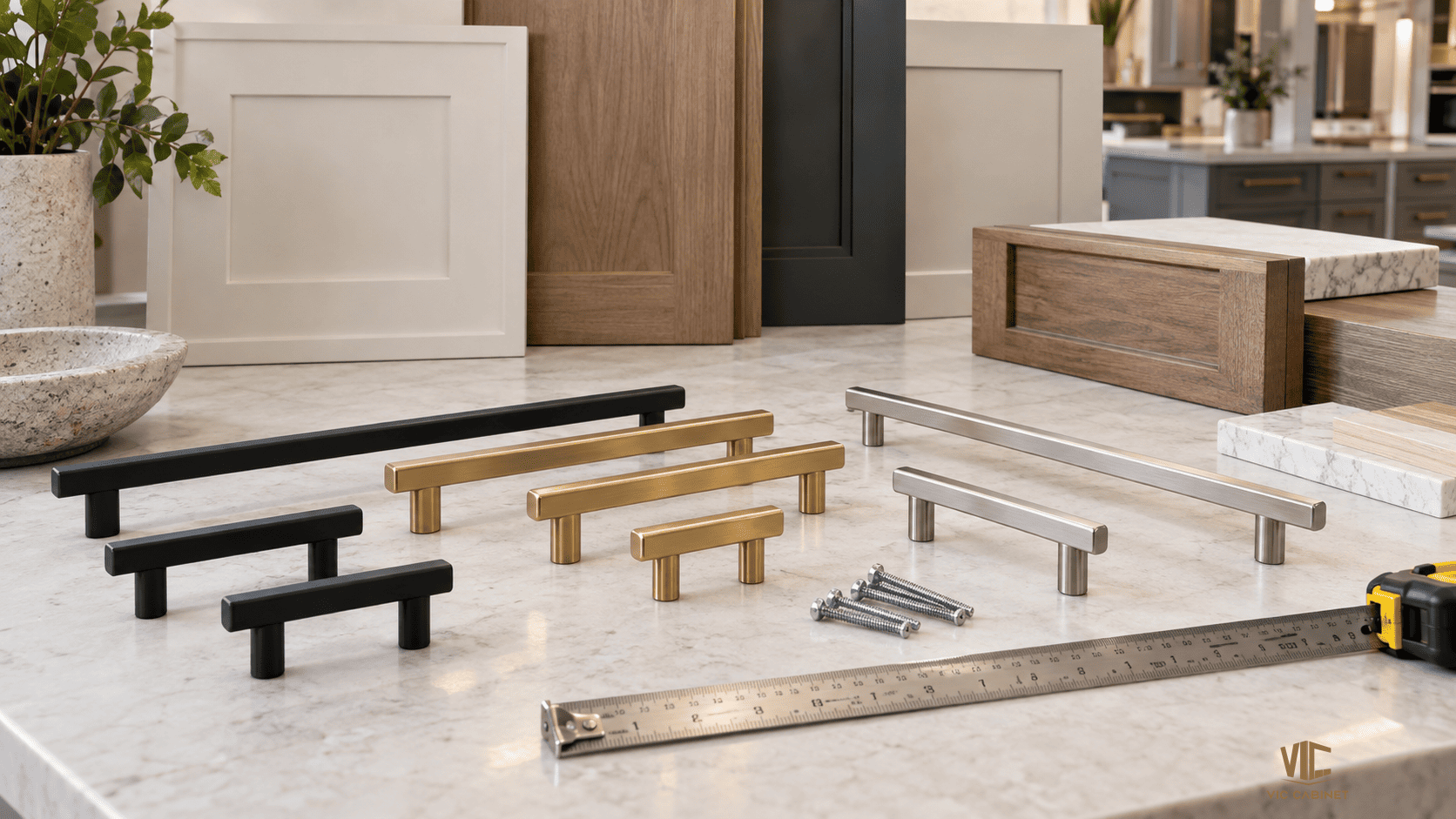
Before ordering, check:
- Center-to-center measurement
- Overall pull length
- Hardware finish
- Screw size
- Available quantity
- Replacement availability
- Lead time
- Finish consistency between batches
Replacement availability is particularly important for distributors, builders, and multifamily projects. If a project uses a highly specialized hardware design that becomes unavailable later, replacing missing or damaged pulls may become difficult. For larger projects, selecting one hardware family with several coordinated sizes can be more practical than using completely different pull designs across different cabinet types.
VIC Cabinet manufactures RTA cabinetry for distributors, builders, and project buyers serving the U.S. market. VIC Cabinet does not manufacture decorative hardware such as cabinet pulls or knobs. However, hardware requirements can be coordinated with cabinet specifications, including pull placement, mounting-hole requirements, and pre-drilling when applicable.
Conclusion
Cabinet pulls should be selected based on cabinet style, front size, finish, and mounting requirements. Bar, cup, edge, and modern cabinet pulls each suit different cabinet designs, while correct center-to-center measurement helps prevent installation problems. For large cabinet projects, selecting hardware early also helps standardize installation, reduce drilling errors, and make future replacement easier.
VIC CABINET – Vietnam cabinet manufacturer
Head Office: Tran Thu Do Street, Hoang Liet, Hoang Mai District, Hanoi, Vietnam
HCM Office: N8 Street, Phu Thuan, District 7, Ho Chi Minh City, Vietnam
Phone: +84 96 781 7316
Website: https://viccabinet.com
Email: info@viccorp.com.vn
