


Choosing cabinet hardware comes down to five practical factors: hardware type, size, hole spacing, finish, and how the piece feels in daily use. The right knobs or pulls should complement your cabinet style without sacrificing comfort or function. This guide explains the main options, sizing rules, finish choices, and buying considerations so you can choose hardware with confidence.
1. What Is Cabinet Hardware?
Cabinet hardware includes the components that help cabinet doors and drawers open, close, and function properly. Some pieces are visible and decorative, while others are hidden inside the cabinet.
The most common types include knobs, pulls, handles, hinges, drawer slides, catches, and latches.

For most homeowners, choosing hardware starts with knobs and pulls because these pieces have the biggest visual impact. However, functional components such as hinges and drawer slides also affect how your cabinets feel every day.
A cabinet with attractive doors can still feel inexpensive if the drawers are difficult to open or the hinges do not align properly.
Decorative hardware includes:
- Knobs
- Bar pulls
- Cup pulls
- Edge pulls
- Handles
Functional hardware includes hinges, drawer slides, catches, and other mechanisms that control movement.
When selecting cabinet door hardware, consider both appearance and function. Hardware should feel comfortable in your hand, work with the size of the door or drawer, and leave enough clearance around nearby cabinets and appliances.
2. How to Choose the Best Cabinet Hardware
The best cabinet hardware is not simply the most expensive option. It is hardware that fits your cabinet proportions, feels comfortable during daily use, and matches the overall design of your kitchen or bathroom.
Start with these five considerations.
2.1. Cabinet Style
Your cabinet door style provides the visual foundation.
Simple Shaker cabinets work with a wide range of hardware, from traditional knobs to clean bar pulls. Flat-panel cabinets generally look better with streamlined pulls, edge pulls, or minimalist handles.
More detailed raised-panel doors often pair well with knobs, cup pulls, or decorative handles.
2.2. Comfort
Do not choose hardware based on photos alone.
Put your fingers behind the pull and check the clearance. Sharp edges, shallow finger space, or very small knobs may become annoying when you open the same drawer dozens of times each day.
The National Kitchen & Bath Association recommends considering accessibility when planning cabinetry and decorative hardware, including minimizing excessive wrist twisting and avoiding hardware that interferes with nearby doors and drawers.
2.3. Construction Quality
Look at more than the finish.
Solid metal hardware usually feels more substantial than thin hollow alternatives. Check the mounting points, threads, screws, and finish consistency before purchasing large quantities.
2.4. Existing Holes
If you are replacing old cabinet hardware, measure the existing holes before shopping.
Using the same center-to-center measurement can save you from filling old holes and drilling new ones.
2.5. Proportion
A tiny pull on a wide drawer can look out of scale. At the same time, an oversized handle can overwhelm a narrow cabinet door.
Always evaluate hardware relative to the actual cabinet dimensions rather than choosing one size for every door and drawer.
3. Cabinet Hardware Types for Different Cabinet Styles
Good cabinet and hardware combinations create a consistent design without making every element match perfectly.

Here are several practical pairings.
| Cabinet Style | Hardware That Works Well | Popular Finish Direction |
| Shaker | Knobs, bar pulls, cup pulls | Brass, black, nickel |
| Flat-panel | Edge pulls, finger pulls, slim bar pulls | Black, chrome, brass |
| Traditional | Knobs, cup pulls, decorative handles | Bronze, brass, nickel |
| Transitional | Simple knobs and straight pulls | Nickel, brass, black |
Shaker Cabinets
Shaker doors are flexible because of their simple frame-and-panel design.
For a classic kitchen, consider round knobs on doors and cup pulls on drawers. For a more contemporary look, straight bar pulls can make the same Shaker door feel cleaner and more modern.
Flat-Panel Cabinets
Flat or slab doors already have a minimal appearance, so bulky hardware can compete with the design.
Edge pulls, finger pulls, and slim handles help maintain clean lines. Long pulls can also emphasize the vertical shape of tall pantry doors.
Traditional Cabinets
Detailed cabinet doors can support more decorative cabinet hardware.
Warm brass, bronze, and classic knobs work particularly well with wood finishes and traditional door profiles.
Transitional Cabinets
A transitional kitchen combines traditional and contemporary elements. Simple knobs paired with straight drawer pulls often provide enough detail without making the space feel too formal.
The goal is not to follow a strict rule. Instead, choose cabinet door hardware that supports the character already established by the cabinet door.
4. How to Choose Cabinet Hardware Size and Finish
Hardware size is one of the easiest details to get wrong because a pull can look completely different on a sample board than it does on a 36-inch drawer.

4.1. Understanding Pull Size
Two measurements are important:
Center-to-center: The distance between the centers of the two screw holes.
Overall length: The complete length of the pull from end to end.
These measurements are not always the same.
For replacement cabinet hardware, center-to-center spacing is especially important because it determines whether the new pull fits the existing holes.
For new cabinets, you have more flexibility.
A practical approach is to use shorter pulls on small doors and progressively longer pulls on wider drawers and pantry doors. On very wide drawers, you can use one longer pull or two smaller pulls depending on the design.
4.2. Choosing the Finish
Common finishes include matte black, brushed nickel, polished chrome, brass, and bronze.
Matte black creates strong contrast against white or light wood cabinets. Brushed nickel tends to feel neutral and works with many stainless steel appliances. Brass adds warmth, especially to white, cream, green, and natural wood cabinets.
Chrome creates a brighter, more reflective appearance and is often used in contemporary interiors.
4.3. Does Everything Need to Match?
No.
Your cabinet hardware does not need to be exactly the same finish as your faucet, light fixtures, or appliances.
A kitchen with stainless steel appliances can still use brass or black hardware. The key is repetition and intention. If one finish appears only once, it may look accidental. Repeating it in two or three areas usually creates a more coordinated result.
5. How to Measure and Install Cabinet Hardware
Accurate placement matters just as much as the hardware itself.
Before drilling, confirm the hardware size, center-to-center spacing, door orientation, and location of adjacent cabinets.
For replacement hardware, measure from the center of one screw hole to the center of the other.
For new installations, a cabinet hardware jig can help maintain consistent placement across multiple doors and drawers.
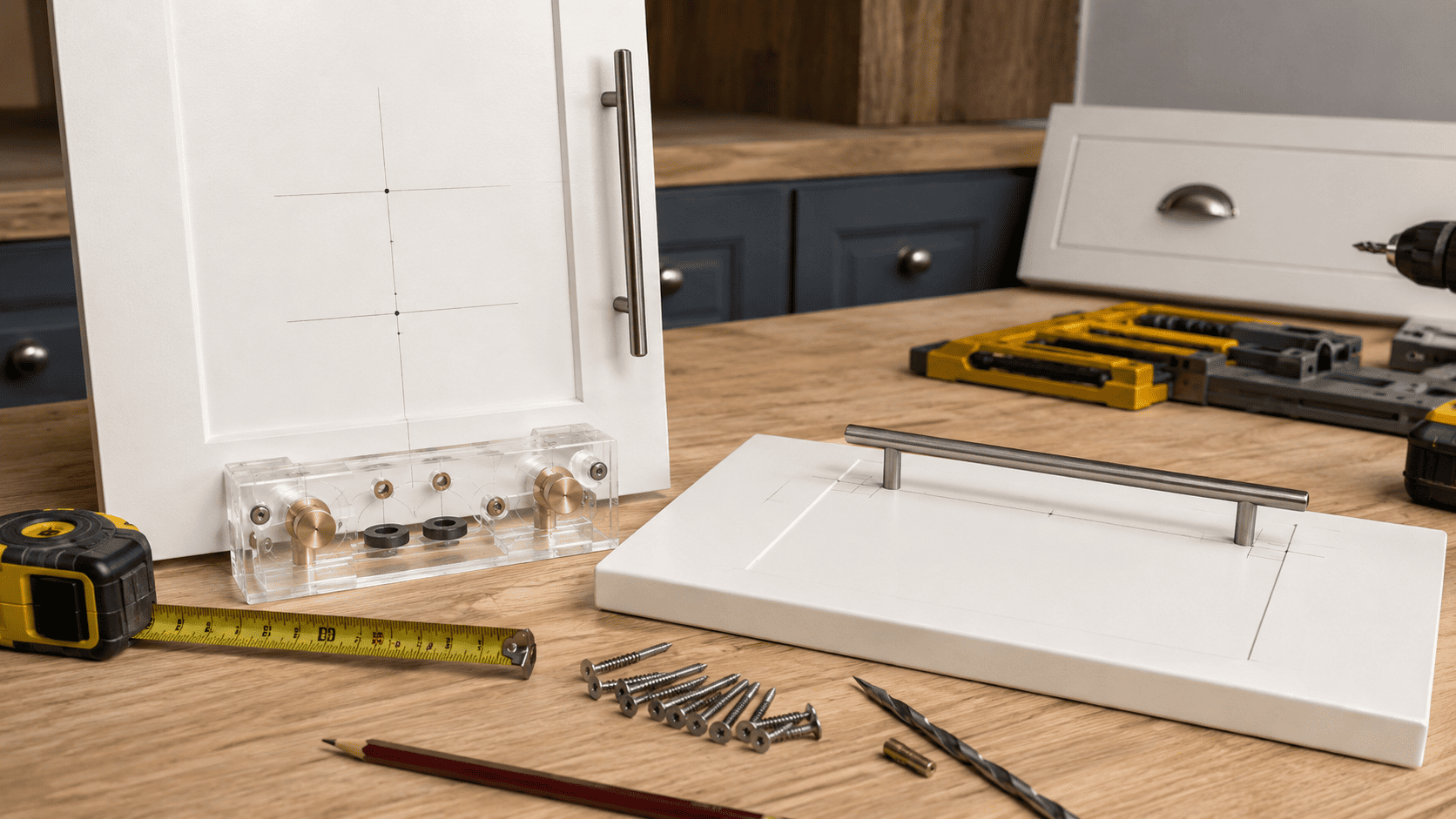
If you are wondering what size drill bit for cabinet hardware is appropriate, a 3/16-inch drill bit is commonly used for many standard 8-32 cabinet hardware screws.
However, do not treat this as a universal rule.
Check the diameter of the screw included with your specific knob or pull. The hole should allow the screw to pass through without excessive movement.
Before drilling a finished cabinet door:
- Mark the exact location.
- Confirm the measurement again.
- Place painter’s tape over the drilling area if needed to reduce surface chipping.
- Drill straight through the door.
- Avoid forcing the bit through the finished surface.
Whenever possible, test your measurement on scrap material before drilling multiple cabinet fronts.
For a full kitchen, even a 1/8-inch placement difference can become noticeable when several handles appear in the same line.
6. Where to Buy Cabinet Hardware and What to Check Before Buying
Searching for cabinet hardware near me is useful when you want to see finishes and dimensions in person before making a decision.
Local stores allow you to hold the hardware, check its weight, compare finishes, and test whether the grip feels comfortable.
Online shopping usually provides a much larger selection.
| Buying Locally | Buying Online |
| See the finish in person | Larger product selection |
| Test grip and weight | Easier price comparison |
| Take products home quickly | More sizes available |
| Limited local inventory | Easier to find specialty styles |
For a small remodel, buying locally may be convenient. For a full kitchen with 30, 40, or more pieces of cabinet hardware, online suppliers may offer more consistent availability.
Before placing a large order, buy one sample whenever possible.
Install it on an actual door or drawer and check:
- Grip comfort
- Projection from the cabinet
- Finish under your kitchen lighting
- Screw length
- Hole spacing
- Clearance around adjacent cabinets
One common mistake is choosing pulls before checking corner conditions. A long pull installed near a perpendicular cabinet can hit another handle, wall, appliance, or drawer.
Also verify screw length. Cabinet doors and drawer fronts vary in thickness, so the included screw may not always fit your application.
Good cabinet hardware should support the design of your kitchen while remaining comfortable enough for everyday use.
Focus on three things first: proportion, center-to-center measurements, and finish. Then check grip, projection, construction quality, and installation requirements.
For homeowners comparing complete cabinet systems, VIC Cabinet manufactures kitchen cabinets, vanities, closets, and RTA cabinetry in Vietnam using materials including plywood, MDF, MFC, acrylic, and solid wood. Hardware selection should always be considered together with the door style and cabinet construction rather than as an isolated decorative decision.
The right cabinet hardware does not need to be complicated. Choose a style that fits your cabinets, measure carefully, test a sample, and prioritize hardware that still feels comfortable after hundreds of uses.
FAQ SECTION
1. What type of cabinet hardware is most popular?
Knobs and pulls remain the most common choices for kitchen cabinets. Straight bar pulls are especially versatile for Shaker, transitional, and modern cabinets, while knobs work well on smaller doors. Cup pulls are often used for traditional or farmhouse-inspired drawers. The best choice depends on your cabinet style, drawer size, finish preference, and how the hardware feels during everyday use.
2. What size cabinet pulls should I use?
There is no single pull size that works for every cabinet. Smaller doors usually look balanced with shorter pulls or knobs, while wide drawers can support longer handles. Pay attention to both the overall pull length and the center-to-center screw spacing. Before ordering hardware for an entire kitchen, install one sample to confirm that the size looks proportional to the cabinet front.
3. Should cabinet hardware match the faucet?
Cabinet hardware does not have to match the faucet exactly. Mixing finishes can make a kitchen feel more layered and intentional. For example, brass pulls can work with a stainless steel faucet, while black hardware can complement stainless appliances. Try to repeat each major finish elsewhere in the room so the combination feels deliberate rather than accidental.
4. What size drill bit should I use for cabinet hardware?
A 3/16-inch drill bit is commonly suitable for many standard cabinet knobs and pulls that use 8-32 machine screws. However, screw dimensions vary by manufacturer. Check the supplied screw before drilling. The hole should be wide enough for the screw to pass through cleanly without leaving excessive play that could allow the hardware to shift after installation.
5. Is it better to buy cabinet hardware near me or online?
Buying locally is useful when you want to see the finish, feel the weight, and test the grip before purchasing. Online stores generally provide more styles, sizes, and finishes. A practical approach is to evaluate samples in person first, then compare local and online pricing once you know the exact dimensions, finish, and hardware style you need.
