


The best kitchen under cabinet lighting balances visibility and design, with low-profile LED strip lights and recessed puck lights being the top functional choices. Adding these fixtures eliminates harsh countertop shadows while transforming your kitchen ambiance. This complete buyer’s guide breaks down the technical specs, sizing strategies, and layout considerations you need to select the perfect under-cabinet illumination system for your modern home.
1. Why Kitchen Under Cabinet Lighting Matters for Modern Kitchens
Standard overhead ceiling fixtures are necessary for general illumination. However, they frequently cast dark shadows directly onto your countertops because your body blocks the downward light source while you are prepping food. Consequently, installing dedicated kitchen lighting fixtures under cabinets resolves this safety issue by providing direct, focused task lighting for chopping, cooking, and reading recipes.
Furthermore, these modern fixtures bridge the gap between essential task visibility and ambient mood lighting. As a result, when the main overhead lights are switched off, low-profile under-cabinet lights create a soft, warm architectural glow that instantly elevates the kitchen’s visual depth. Ultimately, this secondary layer of light eliminates annoying workplace shadows while transforming a sterile cooking space into a welcoming social hub for evening gatherings.
2. Types of Kitchen Lighting Fixtures Under Cabinets
2.1, LED Strip Lights (Tape Lights)
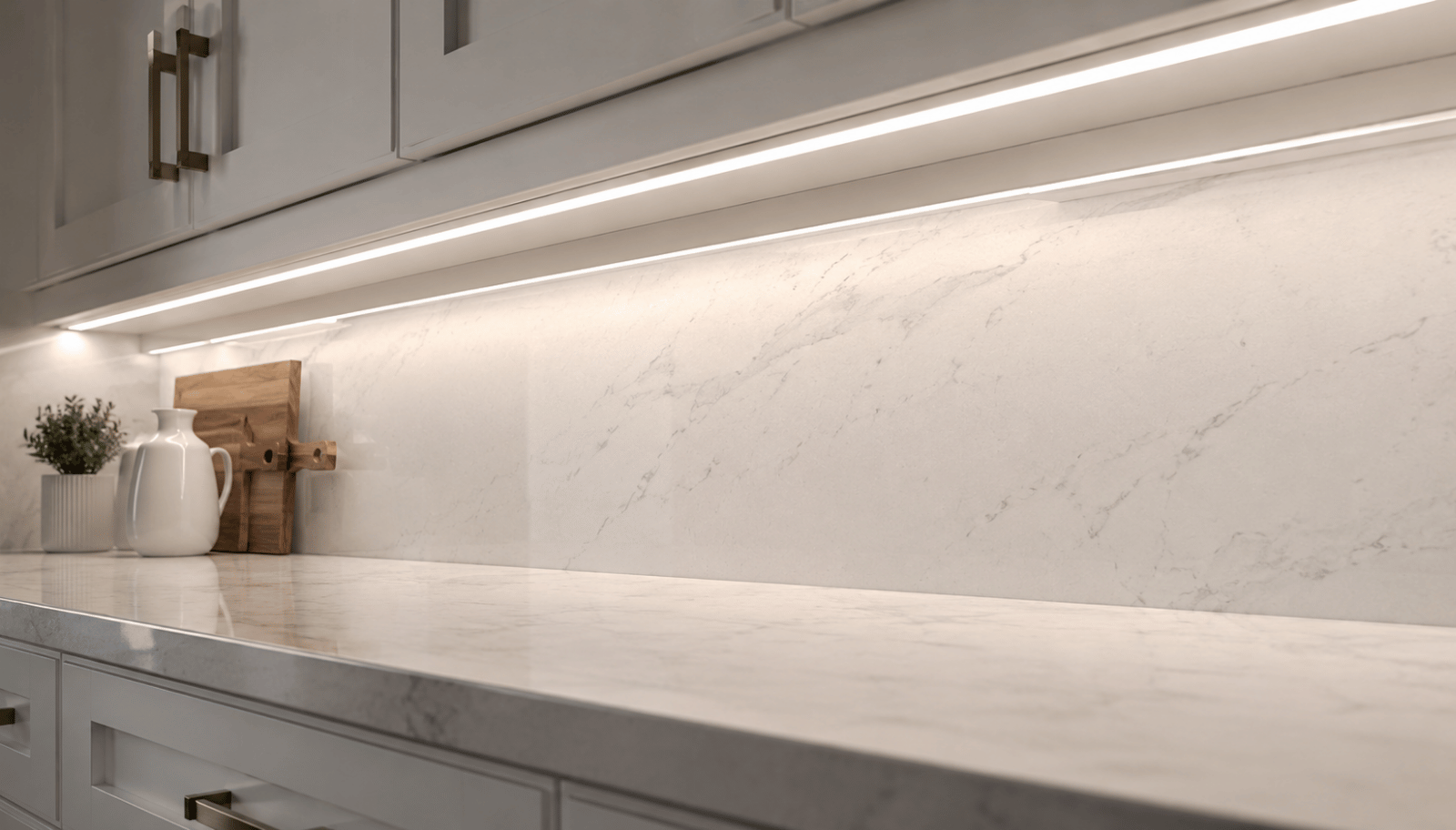
Flexible LED tape lights are the most versatile and popular choice for contemporary homes. Sold on continuous reels, these ultra-thin under cabinet led lights for kitchen applications feature an adhesive backing that sticks directly to the underside of the cabinet carcass. They deliver a completely continuous, seamless line of light without any dark spots between individual bulbs. This makes them highly effective for uniform workspace illumination.
2.2, Puck Lights for Focal Points

Puck lights are small, round discs shaped like hockey pucks that mount at set intervals under the upper cabinets. They create focused, downward-directed triangles of accent light rather than a continuous beam. Puck lights work beautifully when you want to highlight specific design elements, such as a premium espresso station, a beautiful vase, or a high-end sink area.
2.3, Rigid Linear Bar Fixtures
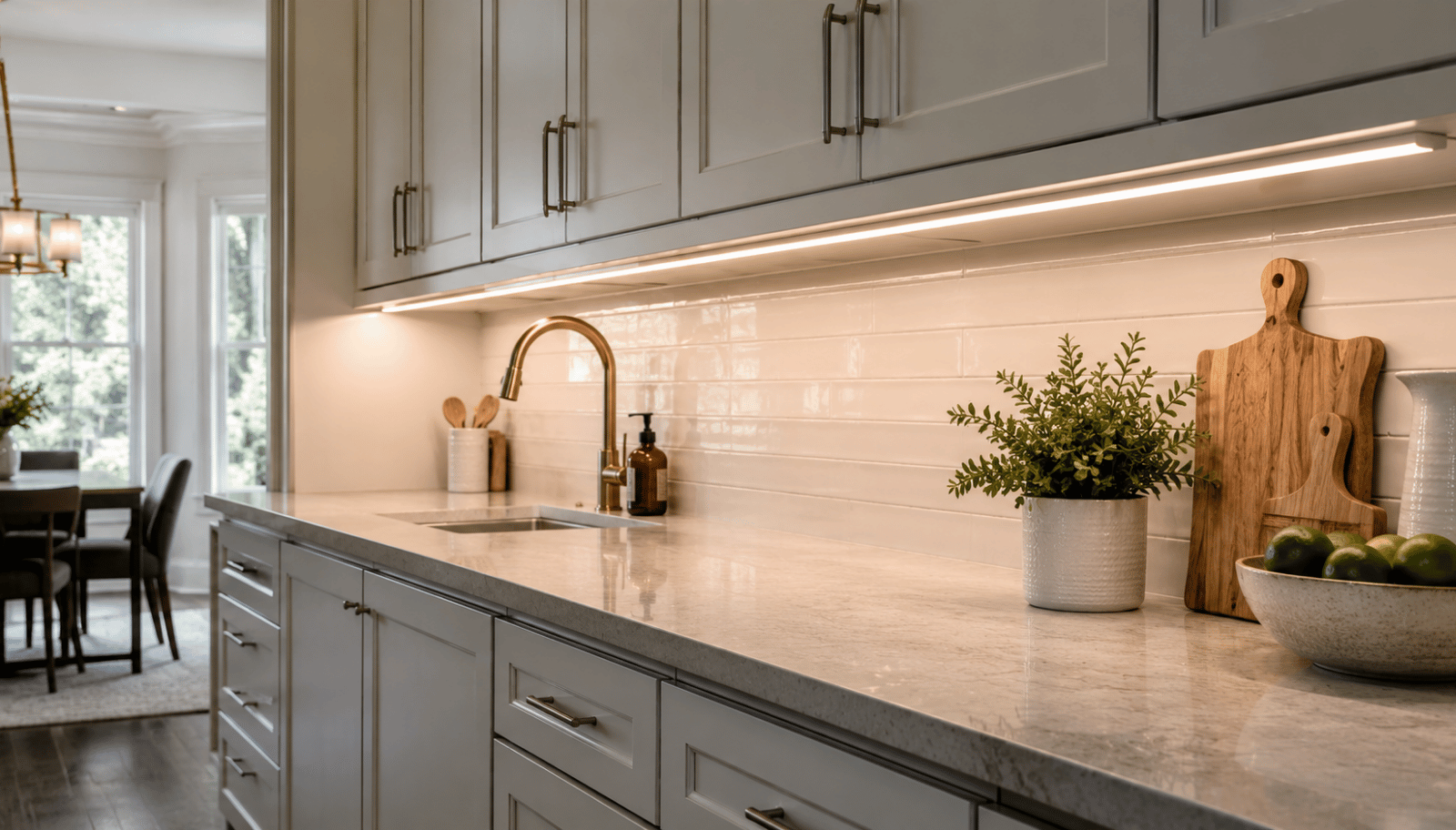
Linear light bars offer a sturdy, heavy-duty housing alternative to flexible tape. These architectural-grade fixtures contain integrated drivers and aluminum backings that act as heat sinks, ensuring maximum longevity. Because they are pre-built to specific lengths, they provide highly consistent, high-intensity light output across straight runs of cabinetry.
2.4, Smart Lighting Integration for Connected Homes

Modern kitchen design increasingly relies on smart under cabinet led lights for kitchen systems integrated with home automation networks. These advanced fixtures connect directly via Wi-Fi or Bluetooth, allowing homeowners to adjust brightness levels or tune color temperatures using smartphone apps, voice commands through Alexa or Google Home, or automatic motion sensors that activate the lights when someone enters the room.
3. Comparing the Most Popular Under Cabinet Lighting Options
Choosing the best under kitchen cabinet lighting involves evaluating several functional trade-offs. The table below compares the core characteristics of the four primary light fixture types to help determine which system matches your project requirements.
| Lighting Type | Brightness Uniformity | Aesthetic Low-Profile | Installation Difficulty | Cost Efficiency | Smart Features Integration |
| LED Strip Lights | Excellent (Continuous) | Superior (Ultra-Thin) | Moderate (Requires track) | High Value | Compatible (With smart controllers) |
| Puck Lights | Fragmented (Scalloped) | Visible if not recessed | Easy (Surface mount) | Budget-Friendly | Limited (Requires smart bulbs/plugs) |
| Linear Light Bars | Very Good (Diffuse) | Semi-Visible profile | Complex (Hardwired) | Premium Investment | High (Often built-in driver protocols) |
| Smart Lighting | Variable (Depends on fixture) | Sleek (Integrated tech) | Moderate to Complex | Higher Initial Cost | Native (App, Voice, Motion sensors) |
4. Power Sources: Wireless Kitchen Cabinet Lighting vs. Hardwired
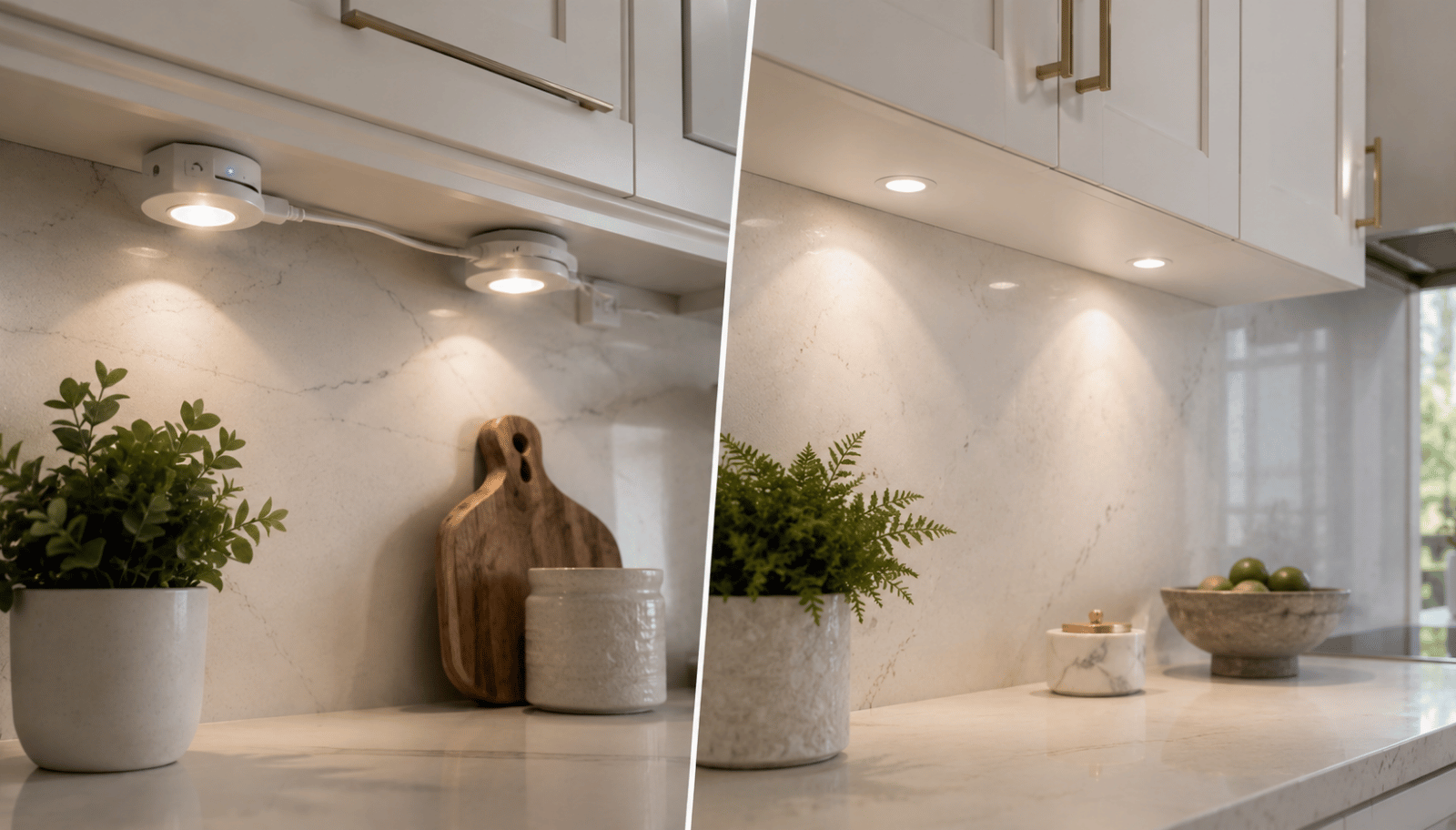
4.1, Plug-In and Battery Operated Under Cabinet Lighting Kitchen Solutions
For quick retrofits and straightforward DIY projects, wireless kitchen cabinet lighting offers immediate convenience without the need to cut into drywall. A battery operated under cabinet lighting kitchen setup uses rechargeable lithium-ion packs or standard AA batteries, mounting instantly via magnetic strips or double-sided tape. Alternatively, a plug in under cabinet lighting kitchen system utilizes a standard power cord routed to an existing backsplash outlet. While easy to set up, wireless options require routine battery recharging, and plug-in models can leave unsightly cords exposed on your backsplash.
4.2, Hardwired Systems for Permanent, Seamless Operation
For custom renovations and new home construction, a hardwired network is the industry gold standard. This method connects the light fixtures directly to your home’s electrical panel via a hidden remote transformer or driver. Hardwiring eliminates all visible cords and batteries, allowing you to control your under-cabinet layout using standard wall switches or dedicated dimmer sliders right alongside your main ceiling lights.
5. How to Choose the Best Under Kitchen Cabinet Lighting for Your Space
5.1, Sizing and Length Selection
To achieve a clean, professional look, the length of your light fixtures must match your layout. As a rule of thumb, select a light fixture or cut an LED tape strip to a length that is 1 to 2 inches shorter than the total interior width of the upper cabinet box. Centering the light inside the under-cabinet cavity ensures that illumination spreads evenly into the corners without creating harsh glare at the outer edges of the casework.
5.2, Kitchen Layout and Countertop Reflection
The layout of your kitchen directly impacts how light behaves. In L-shaped or U-shaped kitchens, ensure light strips overlap at the interior corners to prevent dark dead zones. Furthermore, pay close attention to your countertop material. High-gloss polished granite or quartz countertops act like mirrors, reflecting individual LED bulbs as distracting hot spots. To prevent this reflection, always install a frosted diffusion lens over your LED channels to soften the light beam.
5.3, Cabinet Finish Compatibility
The color and material finish of your cabinets should dictate your light’s color temperature, measured in Kelvin (K). Using the wrong color temperature can make a premium cabinet finish look muddy, washed out, or completely altered.
- Natural Wood Finishes: Rich wood grains like oak, walnut, or cherry thrive under warm white light (2700K to 3000K). This temperature enhances the natural yellow and red undertones of the wood, creating a cozy and high-end feel.
- Modern Painted Finishes: Modern white cabinets or trendy painted finishes, like muted sage green kitchen cabinets, look best under a neutral white light (3500K to 4000K). This cleaner range keeps the paint color looking crisp, accurate, and exactly as the designer intended, preventing white from looking yellow or green from looking dull.
- High-Gloss Acrylic Finishes: For ultra-modern glossy surfaces, stick to a crisp 4000K color temperature. Because glossy finishes reflect everything, neutral white combined with a frosted diffuser lens will provide bright, clean lines without creating harsh, blinding glare.

5.4, Moisture Resistance and Durability Rating
The environment directly underneath upper cabinets faces constant exposure to steam, rising heat, and airborne cooking oils. Fixtures placed directly above a sink or range top must carry an Ingress Protection (IP) rating of at least IP44 or higher. This water-resistant rating ensures that damp air and grease particles cannot penetrate the protective outer casing, preventing short circuits and premature bulb failure.
6. Factory Insights: Designing Kitchen Cabinets with Integrated Lighting Channels
Achieving a flawless, high-end kitchen aesthetic requires meticulous planning well before the lighting hardware is even purchased. However, many builders make the mistake of choosing lighting as an afterthought, which often leads to messy, visible wiring inside the cabinetry. Premium manufacturers design casework with built-in provisions for electrical components. Specifically, at the VIC Cabinet factory, we specialize in producing export-grade cabinets that accommodate integrated lighting channels seamlessly.
Consequently, during our manufacturing process, computer-controlled CNC machinery cuts precise, recessed grooves into the underside of the plywood or MDF cabinet bottom panels. These integrated channels allow builders to snap aluminum LED housings directly flush with the wood surface, thereby completely hiding the fixture from view. Moreover, pre-drilled wire access holes inside the cabinet stiles let contractors route electrical cables invisibly behind the face frames. Therefore, this factory-integrated design completely eliminates cluttered wires inside the storage shelves, delivering the clean, built-in look highly demanded by the American market.
7. How to Install Under Cabinet Lighting Kitchen: 4-Step DIY Guide
If you are using a plug-in or wireless system, learning how to install under cabinet lighting kitchen fixtures is a straightforward weekend project.
- Step 1: Prep and Clean the Surface: Scrub the entire underside of the cabinet carcass thoroughly using rubbing alcohol to remove residual cooking grease. Let it dry completely.
- Step 2: Mark Placement Line: Map out a straight placement line 1 to 2 inches behind the front face frame of the cabinet. Placing fixtures near the front forces the light to beam straight down onto the center of your countertop workspace instead of just highlighting the backsplash.
- Step 3: Secure Fixtures & Route Wires: Mount your LED tape inside an aluminum channel, or secure puck/bar lights using provided wood screws. Route the power cables neatly along the inside lip of the cabinet’s bottom frame using small wire clips spaced every 6 inches to keep cords hidden.
- Step 4: Connect to Power: Plug the cord into your closest backsplash outlet. Bundle any excess wire using a zip tie and conceal it tightly behind the upper cabinet’s light rail or decorative valance.
FAQ
1: Where is the best placement for kitchen under cabinet lighting fixtures?
The best placement is along the front inside edge of the upper cabinet, right behind the front face frame lip or light rail. Mounting the fixtures near the front allows the light to beam straight down across the center of your countertop. If you mount the fixtures too far back against the wall, the light will mostly highlight the backsplash and leave the front half of your work surface in the dark.
2: Should I choose puck lights or LED tape lights for my kitchen under cabinet lighting?
LED tape lights are better if you want smooth, continuous, and even workspace task lighting across your entire countertop without any dark gaps. Puck lights are ideal when you want to create dramatic focal points or ambient accent lighting highlights over specific design areas, such as an open display shelf or a built-in coffee station.
3: What is the ideal color temperature for kitchen lighting fixtures under cabinets?
For most traditional wood styles, a warm white color temperature between 2700K and 3000K provides a cozy, inviting atmosphere. For modern kitchens with white or painted cabinets, a neutral white light between 3500K and 4000K is highly recommended. It keeps the space looking clean, crisp, and true to color without making the paint look yellow or muddy.
4: Can I install under-cabinet LED lights myself without a professional electrician?
Yes, you can easily install plug-in or battery operated under cabinet lighting kitchen models yourself using simple household tools. These consumer-friendly systems secure with adhesive backing or small screws and plug directly into standard wall outlets. However, if you want a permanent hardwired system controlled by a wall switch, you should hire a licensed electrician to ensure safe installation.
