


Unfinished kitchen base cabinets cost 20% to 40% less than pre-finished alternatives, making them a top choice for budget-conscious projects. By purchasing raw wood units, you gain full control over the paint or stain color while keeping procurement costs low. This guide highlights how to evaluate raw cabinet quality and source durable options at factory prices.
1. Why High-Volume Projects Rely on Unfinished Kitchen Base Cabinets
1.1. Upfront Savings on Affordable Kitchen Base Cabinets
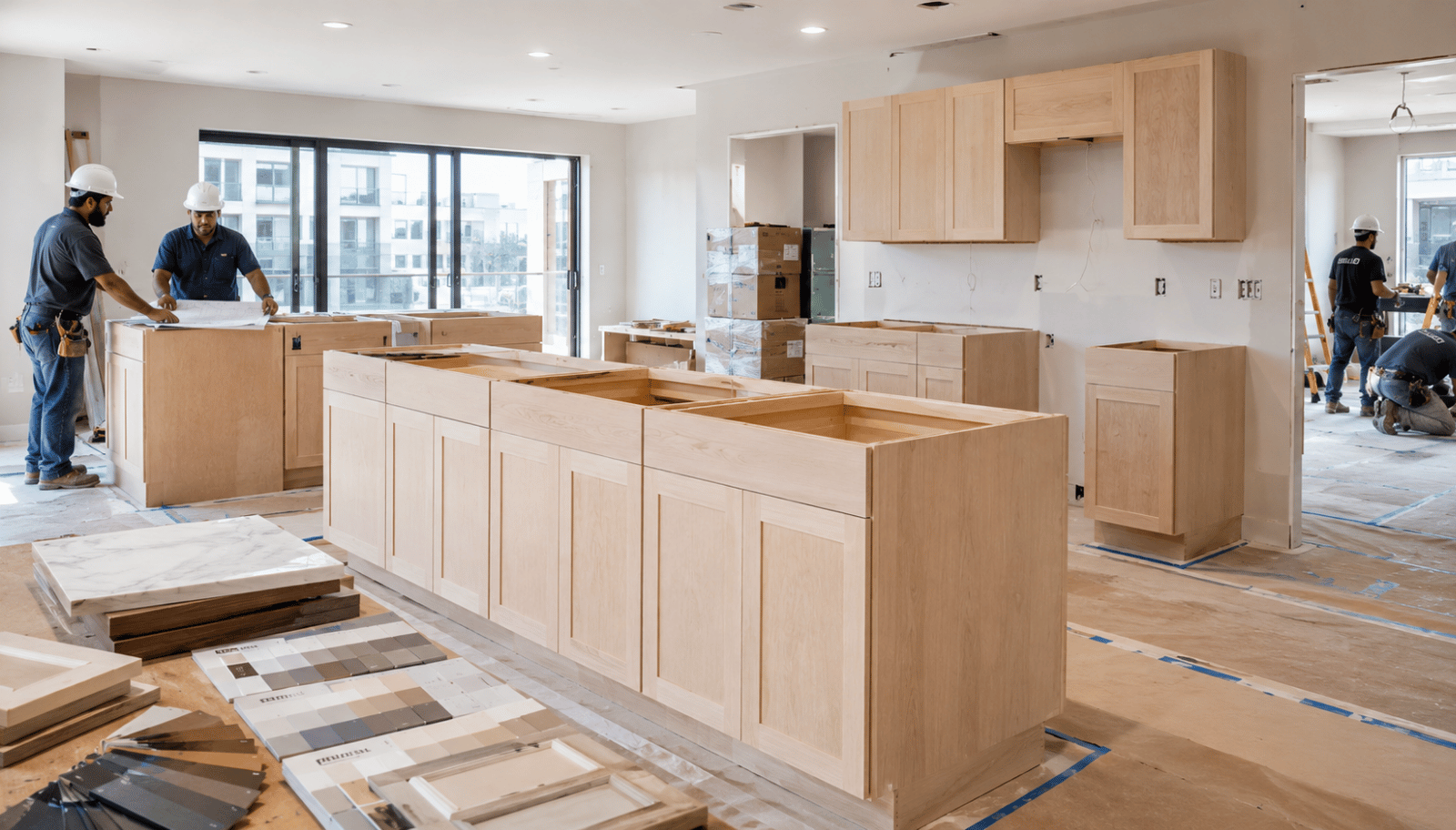
Every dollar saved on materials directly improves your bottom line. Sourcing unfinished kitchen base cabinets allows volume buyers to eliminate the costly factory-finishing premium right from the start. These raw structural units offer highly competitive, cheap kitchen base cabinets pricing without requiring you to sacrifice the core durability of the product.
For multi-family housing developments or large subdivision builds, choosing affordable kitchen base cabinets frees up significant capital. Procurement managers can reinvest these upfront savings into high-traffic hardware upgrades or premium stone countertops, increasing the property value without breaking the total budget.
1.2. Complete Design Flexibility and Customization
Relying on pre-finished factory stock often locks your project into generic, mass-produced colors that may not match local market demands. Raw cabinetry gives independent cabinet distributors and regional millwork shops a competitive edge. You can apply regional stain trends or hyper-specific custom paints on demand, adapting quickly to shifting architect specifications without holding slow-moving inventory.
You can apply regional stain trends or hyper-specific custom paints on demand, adapting quickly to shifting architect specifications without holding slow-moving inventory. However, before finalizing raw bulk orders, procurement managers must double-check that the specified architectural layouts strictly follow standard kitchen base cabinet dimensions to eliminate on-site spatial conflicts during final assembly.
2. Unfinished vs. Pre-Finished Base Cabinets: Operational Comparison
Before placing a container order, commercial buyers must weigh lower acquisition costs against the realities of local finishing labor. The breakdown below outlines how discount kitchen base cabinets compare to pre-finished inventory on the job site:
| Operational Factor | Unfinished Base Cabinets | Pre-Finished Base Cabinets |
| Initial Purchase Price | Lowest (Factory-direct raw pricing) | Higher (Includes factory coating labor) |
| Estimated Labor Cost | Higher on-site/shop prepping and spraying | Minimal (Immediate box installation) |
| Best Use Case | Custom color matching; regional multi-family builds | Fast-track projects with standard color specs |
| Recommended Buyer Type | Cabinet distributors, regional millwork shops | General contractors, quick-turn remodelers |
| Long-Term Flexibility | Maximum (Easy to sand down, modify, or repaint) | Low (Requires heavy stripping to change colors) |
| Sourcing Channel | Wholesale base kitchen cabinets supply | Standard retail or localized dealer networks |
3. Four Technical Benchmarks for Evaluating Raw Cabinetry Quality
Low pricing means nothing if the raw boxes fail on the job site. When evaluating discount kitchen base cabinets, procurement teams must inspect specific factory construction details to prevent costly warranty callbacks.

3.1. Solid Wood vs. Plywood Box Construction
The cabinet box must support heavy quartz or granite tops without sagging. Commercial buyers should avoid low-grade particleboard boxes, which swell and fail when exposed to moisture under the sink. Insist on 1/2-inch or 3/4-inch grade-A plywood box construction. For face frames and door stiles, solid hardwoods like birch or maple are essential because they hold mechanical fasteners tightly and resist daily impacts.
Insist on 1/2-inch or 3/4-inch grade-A plywood box construction. For example, when sourcing a volume run of the standard 24 inch base kitchen cabinet, solid hardwoods like birch or maple are essential for the face frames because they hold mechanical fasteners tightly under the stress of heavy stone countertops.
3.2. Drawer Glides and Box Joinery
Drawer boxes take the most physical abuse in any layout. High-quality wholesale base kitchen cabinets feature solid wood drawer sides assembled with interlocking dovetail joinery. Avoid factories that rely on staples or plastic corner brackets. For the hardware package, specify under-mount, soft-close drawer glides to ensure smooth operation under heavy residential loads.
3.3. Surface Sanding Quality and Prep Readiness
A flawless paint job requires a perfectly prepared raw surface. Top-tier factory-direct units undergo multi-stage mechanical sanding using 120-grit to 180-grit abrasives before packing. Inspect the raw shipments for cross-grain scratches or glue squeeze-out at the joints. Excessive glue residue blocks stain penetration, which creates uneven, blotchy patches during finishing.
3.4. Wood Species Consistency and Grain Matching
A major risk with cheap kitchen base cabinets is wood species mixing within the same batch. Different woods absorb stains differently and expand at varying rates under humidity shifts, causing paint coats to crack over time. Professional export production requires strict wood sorting. Ensure all face frames and doors use identical wood species with matched grain patterns to guarantee a uniform appearance after coating.
4. Bypassing Middlemen for Wholesale Base Kitchen Cabinets Pricing
4.1. The Financial Impact of Factory-Direct Importing
Sourcing through traditional domestic supply chains means paying for multiple layers of middleman markups, regional warehousing overhead, and domestic logistics costs. Volume buyers, large remodeling contractors, and independent dealers can bypass these unnecessary expenses by establishing direct purchasing lines with overseas manufacturing plants.
4.2. Sourcing Container Loads from Vietnam
For large-scale residential developments or regional wholesale distribution, importing direct container loads from Vietnam is a highly efficient supply chain strategy. Modern Vietnamese factories combine automated machinery with optimized production workflows to deliver exceptional volume pricing. This allows US businesses to maintain steady material supplies while fully satisfying strict US trade and environmental standards.
5. Managing the Local Finishing Process Safely

Shifting the finishing process from the overseas factory to your local workshop requires clear operational oversight. While unfinished units speed up initial factory lead times, your local team must maintain a clean, dust-free environment for priming and painting.
Always use high-solids, oil-based or shellac-based primers to seal the raw wood pores properly. This step prevents natural wood tannins from bleeding through and discoloring your topcoat. For the final finish, industrial-grade acrylic urethane paints or professional stains provide the long-term durability required to meet American residential standards.
For the final finish, industrial-grade acrylic urethane paints or professional stains provide the long-term durability required to meet American residential standards. To ensure complete visual consistency across the entire installation layout, remember to prep and spray your matching architectural trim pieces following a professional kitchen cabinet base molding guide concurrently with the raw base units.
6. Scale Your Sourcing with VIC Cabinet
When your project volume outgrows local distributor stocks, securing a direct manufacturing partner is the next step to protect your margins. VIC Cabinet operates a modern production facility in Vietnam, specializing in manufacturing high-quality kitchen cabinets, vanities, and closet systems for the US export market.
We offer reliable OEM capabilities, building unfinished kitchen base cabinets to your exact architectural submittals and wood specifications. Our factory uses certified plywood and solid hardwoods that comply fully with CARB Phase 2 and EPA TSCA Title VI standards. By shipping direct container loads from Vietnam, VIC Cabinet helps you secure stable wholesale base kitchen cabinets pricing with predictable shipping timelines and strict quality control.
Contact our export team to discuss your project requirements, verify our MOQs, and request a factory-direct container quote.
FAQ
1, Do unfinished kitchen base cabinets need to be sanded before painting?
Yes, industrial wood surfaces always require a final light sanding before applying coatings. Although quality factory-direct units arrive pre-sanded from production, the wood grain naturally expands when exposed to humidity shifts during container transit. A quick sand with 220-grit sandpaper eliminates these microscopic imperfections, ensuring optimal adhesion for commercial primers and topcoats.
2, What is the best wood type for cheap kitchen base cabinets that will be painted?
Hardwoods featuring tight, uniform grain structures such as birch, maple, or high-density paint-grade MDF are ideal for painted finishes. Species with open pores, like red oak, require labor-intensive grain filler steps to achieve a perfectly flat appearance. Birch offers an exceptional combination of structural density, durability, and cost efficiency for commercial projects.
3, Can I install unfinished cabinets before applying the paint or stain?
It is highly recommended to coat the cabinet doors, drawer fronts, and face frames before performing the final wall installation. Spraying components horizontally on drying racks prevents paint runs, sags, and uneven coating thicknesses. Finishing the cabinetry components prior to assembly also ensures all hidden edges are sealed against moisture entry.
4, Do imported cabinets from Vietnam meet US safety and environmental regulations?
Established export manufacturing plants in Vietnam manufacture all products to satisfy strict US environmental mandates. Reputable factories use wood materials that carry verified certifications for CARB Phase 2 and EPA TSCA Title VI compliance. Professional buyers should always request official testing documentation when setting up an international factory-direct supply chain.
