


An RTA bathroom vanity is a flat-packed, ready-to-assemble cabinet that costs 30 to 60 percent less than semi-custom alternatives without sacrificing structural quality. The best RTA bath vanity combines 3/4-inch plywood box construction, dovetail drawer boxes, and a moisture-resistant finish rated for humidity above 70% RH. This guide delivers the material specs, installation tolerances, and failure modes most buyers only discover after purchase.
1. What Is an RTA Bathroom Vanity?
Ready-to-assemble bathroom vanities ship flat-packed in protective cartons, with pre-drilled holes, pre-finished interiors, and all hardware included. The buyer assembles the box on-site, connects plumbing, and installs the countertop separately.
This model eliminates factory labor costs and reduces freight cube by an estimated 60 to 70 percent compared to fully assembled units. For buyers, that translates directly into lower purchase price without compromising the structural integrity of the cabinet itself — provided the construction specs meet bathroom-grade standards.
What most buying guides skip: the cost savings mean nothing if the cabinet material fails within three to five years due to bathroom humidity. The material selection, edge banding specification, and finish adhesion rating are what separate a long-term investment from an expensive replacement project.
2. RTA Bathroom Vanity Cabinets: Material Specification Breakdown
This is the most critical section any buyer should read before placing an order. The bathroom environment is categorically more demanding than a kitchen. Ambient humidity regularly exceeds 80% RH during showers, and surface condensation from cold pipes accelerates material degradation at joints and exposed edges.

2.1. Plywood vs. Particleboard vs. MDF: What the Numbers Actually Mean
| Material | Density (lbs/ft³) | Moisture Resistance | Screw Pull Strength | Typical Lifespan (Bathroom) |
| Baltic Birch Plywood (13-ply) | 35–38 | High (cross-grain structure) | 1,800–2,200 lbs | 15–25 years |
| Standard Plywood (7-ply) | 28–32 | Moderate | 1,200–1,500 lbs | 10–15 years |
| MDF (Medium Density Fiberboard) | 44–50 | Low (swells at edges) | 900–1,100 lbs | 5–8 years |
| Particleboard | 38–45 | Very Low (delamination risk) | 600–850 lbs | 3–6 years |
2.2. Edge Banding: The Spec Most Buyers Never Ask About
Exposed panel edges are the most vulnerable point in any bathroom cabinet. When edge banding fails, moisture infiltrates the substrate and triggers delamination from the inside out — invisible until structural failure occurs.
- 0.5mm PVC edge banding: Budget standard. Adhesion rated to 140°F. Peeling commonly reported within 2 to 4 years in steam-heavy bathrooms.
- 1mm PVC edge banding: Mid-grade standard. More impact resistant, better adhesive bond.
- 2mm PVC edge banding with hot-melt EVA adhesive: Professional grade. Impact resistant, rated to 185°F, moisture-repellent at joints.
2.3. Finish and Surface Coating Standards
| Finish Type | VOC Content | Hardness (Pencil Scale) | Moisture Barrier Rating |
| Thermofoil (PVC wrap) | Near zero | 2H | Moderate — susceptible to heat delamination |
| Catalyzed Lacquer | Low | 3H–4H | High |
| UV-Cured Acrylic | Near zero | 5H–6H | Very High |
| Paint (water-based) | Low-Medium | HB–H | Low-Moderate |
2.4. Drawer Box Construction and Hardware Specifications
Drawer box construction is where most RTA bathroom vanity cabinets cut corners that aren’t visible at purchase.
- Stapled/glued butt-joint drawer boxes: Common in entry-level RTA. Joints fail under lateral stress within 2 to 5 years.
- English dovetail drawer boxes: 14-tooth interlocking joint. No mechanical fasteners needed. Rated for 75,000+ open/close cycles.
- Undermount soft-close slides (Blum Tandembox or equivalent): Full-extension (22″), 100 lb rated, 30,000-cycle tested.
3. Sizing Guide for RTA Vanity Cabinets: Tolerances That Matter

3.1. Standard Width Options and Space Planning
RTA bathroom vanities are available in standard widths: 24″, 30″, 36″, 48″, 60″, and 72″. What most size guides omit: the nominal width and the actual cabinet width differ by the face frame projection.
- Frameless (European-style) RTA vanities: actual width equals nominal width.
- Face-frame RTA vanities: actual opening is 1″ to 1-1/4″ narrower than nominal width per side.
This affects undermount sink selection. A 30″ face-frame vanity accommodates a maximum undermount bowl width of approximately 16″ to 17″. A 30″ frameless vanity accommodates up to 18″ to 19″.
3.2. Height and ADA Compliance
| Vanity Height | Application | ADA Compliant |
| 30″–32″ | Children’s bathrooms, traditional design | No |
| 33.5″–34.5″ | Standard adult use | No (borderline) |
| 34″–36″ | Comfort height / universal design | Yes (with knee clearance) |
ADA-compliant installations require a minimum 27″ knee clearance height beneath the counter and 30″ wide clear floor space. Floating RTA bathroom vanity configurations are the most practical ADA solution, since they allow bracket height adjustment during installation.
3.3. Depth Considerations Beyond Storage
Standard vanity depth is 21″. However, depth directly affects:
- Plumbing offset: Most rough-in drain locations sit 12″ to 15″ from the finished wall. A 21″ deep vanity positions the sink drain 9″ to 12″ from the front of the cabinet — within the standard bowl recess zone for most undermount sinks.
- Door swing clearance: Cabinet doors on a 21″-deep vanity swing to 21″ + door thickness (approximately 3/4″). In bathrooms under 60″ wide, this can conflict with toilet access or shower entry.
- Shallow-depth RTA vanities (14″–18″): Available for powder rooms and tight layouts. Confirm that chosen plumbing rough-in aligns, as shallow cabinets may require a p-trap offset fitting.
Small bathrooms require more than just compact dimensions. Layout efficiency, storage access, and visual openness all matter. For more inspiration, explore our guide to Vanity Cabinet Ideas for Small White Oak and Modern Bathrooms.
4. Counter-Intuitive Reality: Why a $900 RTA Vanity Can Outperform a $2,500 Semi-Custom Unit
This is where most guides stop short of telling buyers the full picture. The assumption that semi-custom or custom vanities automatically outperform RTA bathroom vanities is not supported by material analysis.

Here’s why: a semi-custom vanity built on particleboard substrate with thermofoil facing — a combination commonly found in mid-range showroom options — will fail in a high-humidity bathroom environment in 5 to 7 years. Meanwhile, an RTA bath vanity built on 13-ply Baltic Birch with UV-cured finish and dovetail drawer boxes will outlast it by a decade.
Price does not equal substrate quality. Ask for the spec sheet, not the price tag.
What to ask any RTA vanity supplier before purchasing:
- Box material: plywood, MDF, or particleboard?
- Edge banding: thickness and adhesive type?
- Drawer box: dovetail or butt-joint? Solid wood or plywood?
- Slides: undermount or side-mount? Cycle rating?
- Finish: KCMA A161.1 certified?
5. Installation Notes for RTA Bath Vanity Cabinets
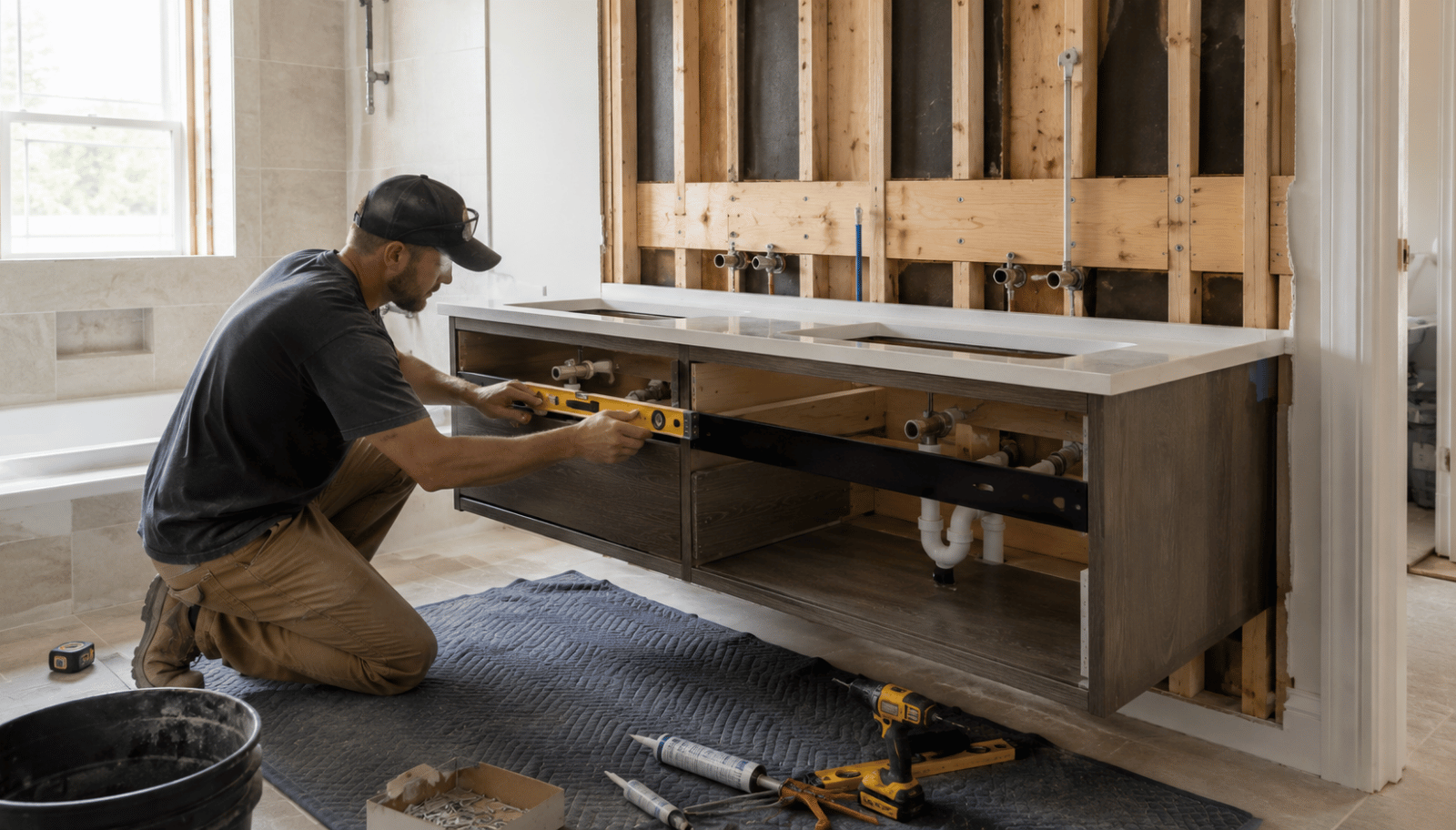
5.1. Floating vs. Freestanding: Structural Requirements
Floating (wall-mount) RTA bathroom vanities require wall blocking or a ledger board rated to carry the combined load of cabinet, countertop, sink, and water — typically 150 to 300 lbs for a 36″ unit. Standard 1/2″ drywall cannot support this load independently.
Blocking specification: Install 3/4″ plywood blocking between studs at the mounting height before finishing the wall. Minimum 16″ vertical blocking zone. Use 3/8″ lag screws into studs (not toggle bolts) for load-bearing installations.
Freestanding vanities distribute load to the floor and require only wall attachment at the back for lateral stability — typically two 3″ screws through the back panel into a stud.
5.2. Plumbing Alignment Checklist
Before finalizing your RTA vanity order, verify:
- Drain rough-in location (center of drain from finished wall)
- Supply line stub-out height (standard: 21″ to 24″ AFF)
- Hot/cold line spacing (standard: 8″ center to center)
- Drain height relative to vanity floor (P-trap must clear cabinet floor by minimum 2″)
5.3. Moisture Sealing at Installation
Even the highest-quality RTA bathroom vanity cabinet requires field sealing at installation joints. Apply a bead of 100% silicone (not latex caulk) at:
- Cabinet-to-wall joint (back and sides)
- Countertop-to-cabinet joint
- Toe kick seam at floor level
Latex caulk shrinks and cracks within 12 to 18 months in bathroom humidity cycles. Silicone maintains elasticity through a temperature range of -65°F to 400°F and remains flexible through 20+ years of thermal cycling.
6. Maintenance Protocol for Long-Term Performance
Vic Cabinet’s recommended maintenance schedule for RTA bathroom vanity cabinets:
Monthly:
- Wipe cabinet exteriors with a damp cloth and dry immediately. No standing moisture on any surface.
- Check under-sink area for supply line or drain leaks. Early detection prevents substrate damage.
Every 6 Months:
- Inspect door hinge screws — tighten any that show play. Hinge movement accelerates wood fiber compression around screw holes.
- Check soft-close slide adjustment. Blum undermount slides have a 3-point adjustment system (height, side, depth). A 0.5mm misalignment increases wear rate significantly.
Annually:
- Re-caulk cabinet-to-wall joint if any cracking or separation is visible.
- Apply furniture wax or cabinet polish to painted or wood-veneer exteriors to maintain finish integrity.
What to avoid:
- Ammonia-based cleaners (damage lacquer and UV-coat finishes)
- Abrasive sponges or steel wool on any painted surface
- Placing wet towels or damp items on open cabinet shelves without a liner
FAQ: RTA Bathroom Vanity Questions Answered
Q: Are RTA bathroom vanities durable enough for daily use?
A: Yes — when built on plywood box construction with dovetail drawer boxes and KCMA-certified finishes. Cabinet longevity is determined by material specification, not assembly method. A plywood RTA vanity will outlast a particleboard pre-assembled unit in every measurable metric.
Q: How long does it take to assemble an RTA bath vanity?
A: A single-sink RTA vanity (24″ to 36″) takes 45 to 90 minutes for most homeowners using standard tools (screwdriver, rubber mallet, level). Countertop installation and plumbing connection add 1 to 2 additional hours.
Q: Do RTA bathroom vanity cabinets come with countertops?
A: Most RTA vanities are sold as base-only units to allow countertop material selection (quartz, marble, solid surface, laminate). This separation is a feature, not a limitation — it allows independent upgrading of either component.
Q: What is the best finish for a high-humidity bathroom?
A: UV-cured acrylic or catalyzed lacquer rated to KCMA A161.1 standards. Both outperform thermofoil (PVC wrap) in steam and humidity resistance. Avoid painted MDF doors in bathrooms without adequate ventilation.
VIC CABINET FACTORY – Vietnam cabinet manufacturer
Head Office: Tran Thu Do Street, Yen So Ward, Hanoi, Vietnam
HCM Office: N8 Street, Phu Thuan, District 7, Ho Chi Minh City, Vietnam
Phone: +(84) 986 119 249
Website: https://viccabinet.com
Email: info@viccorp.com.vn
