


LED kitchen cabinet lighting improves countertop visibility, reduces shadows and creates a cleaner, more functional kitchen. For most new cabinets, LED tape installed in a recessed aluminum channel provides the most even and discreet result. LED bars suit retrofit projects, puck lights work best for displays, and recessed fixtures fit custom designs. This guide explains how to choose and plan the right system.
1. What Is LED Kitchen Cabinet Lighting?
LED kitchen cabinet lighting refers to lighting fixtures installed under, inside, above or around kitchen cabinets. The most common application is lighting under upper cabinets, where fixtures illuminate the countertop and backsplash below.
LED lighting may also be used:
- Inside glass-door cabinets
- Inside drawers and pantry cabinets
- Above wall cabinets
- Along cabinet toe kicks
- Inside recessed channels in cabinet panels
The main purpose of LED lighting under kitchen cabinets is to eliminate dark areas that ceiling fixtures may not reach. When someone stands in front of a countertop, their body can block overhead light and create shadows across the work surface. Under-cabinet lighting places the light source closer to the countertop, improving visibility where food preparation takes place.
LEDs are especially suitable for cabinetry because they are available in slim profiles and produce relatively little heat compared with many traditional lighting options. They can also provide long operating life and lower energy consumption when paired with the correct driver and controls.
The quality of the result, however, depends heavily on the fixture type and how it is integrated into the cabinet.
2. Types of LED Lighting for Kitchen Cabinets
There is no single lighting system that works best for every kitchen. The right choice depends on whether the cabinets are new or existing, whether the fixture should remain hidden and whether the project requires task lighting or decorative lighting.
2.1. LED Tape Lighting for Kitchen Cabinets
LED tape lighting consists of small LED chips mounted along a flexible strip. The tape can be cut at designated points and installed inside an aluminum channel with a diffuser.
Its slim profile makes it one of the most flexible choices for modern kitchen cabinetry. When properly installed, LED tape lighting for kitchen cabinets creates a continuous line of light rather than separate bright spots.
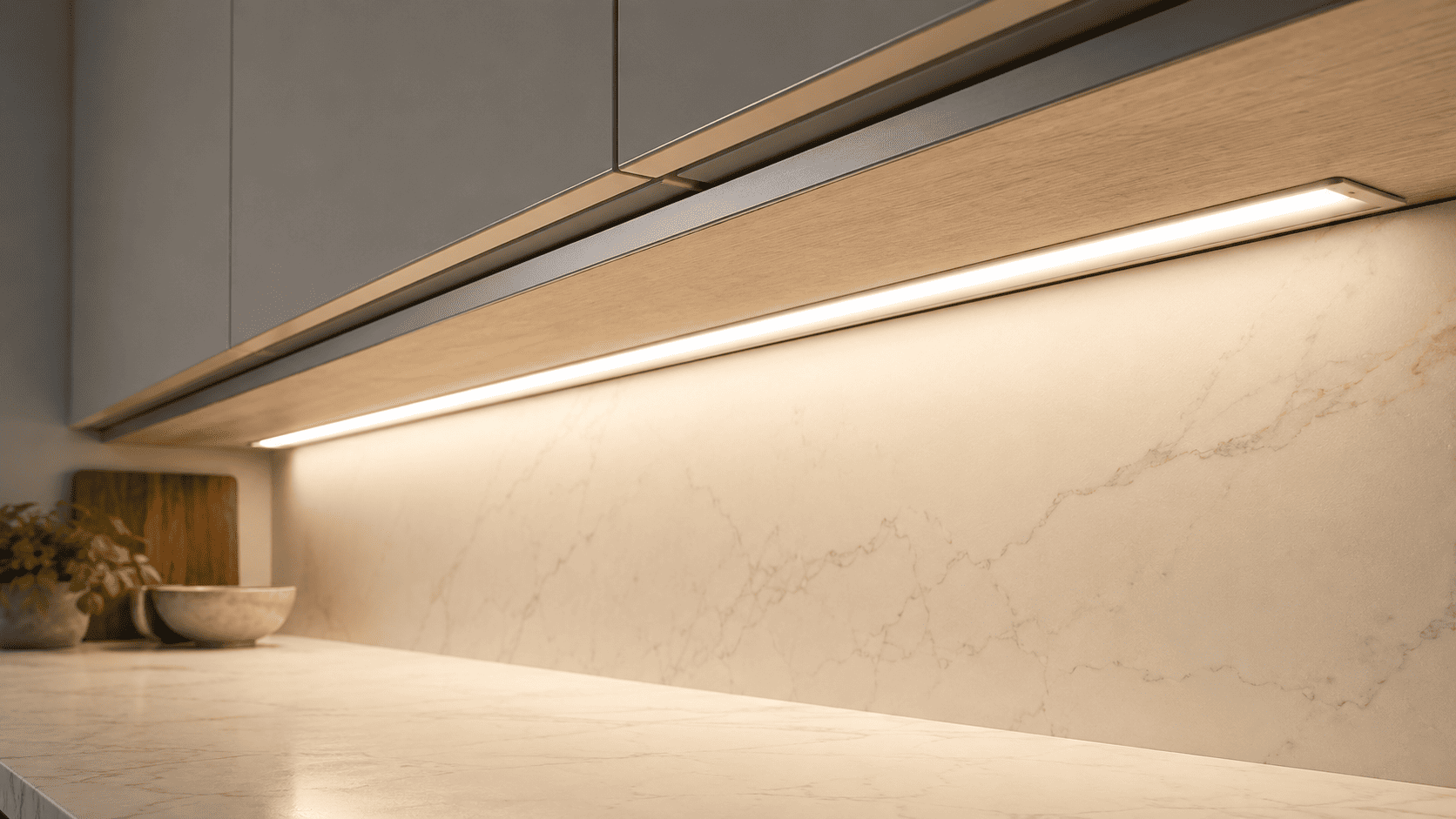
It works well for:
- Under upper cabinets
- Inside display cabinets
- Cabinet toe kicks
- Open shelves
- Recessed channels
- Long countertop runs
For new cabinet projects, the aluminum channel can be recessed into the cabinet bottom panel. This creates a cleaner appearance and reduces the visibility of the fixture.
A diffuser should normally be used over the LED tape. It helps protect the strip and softens the individual LED points. Without a diffuser, reflections from polished countertops or glossy backsplashes may reveal visible dots.
The lighting result also depends on LED density. Strips with wider spacing between chips are more likely to create uneven illumination, particularly when installed close to a reflective surface.
LED tape requires a compatible driver, so the project team must plan where the driver will be placed and how it can be accessed for maintenance.
2.2. LED Light Bars for Under Kitchen Cabinets
LED light bars are rigid fixtures that contain LEDs within a finished housing. They are available in different lengths and can often be connected to create a longer lighting run.
Light bars are a practical option for existing kitchens because they usually require less cabinet modification than recessed tape lighting. Many models are available as plug-in systems, while others can be hardwired.
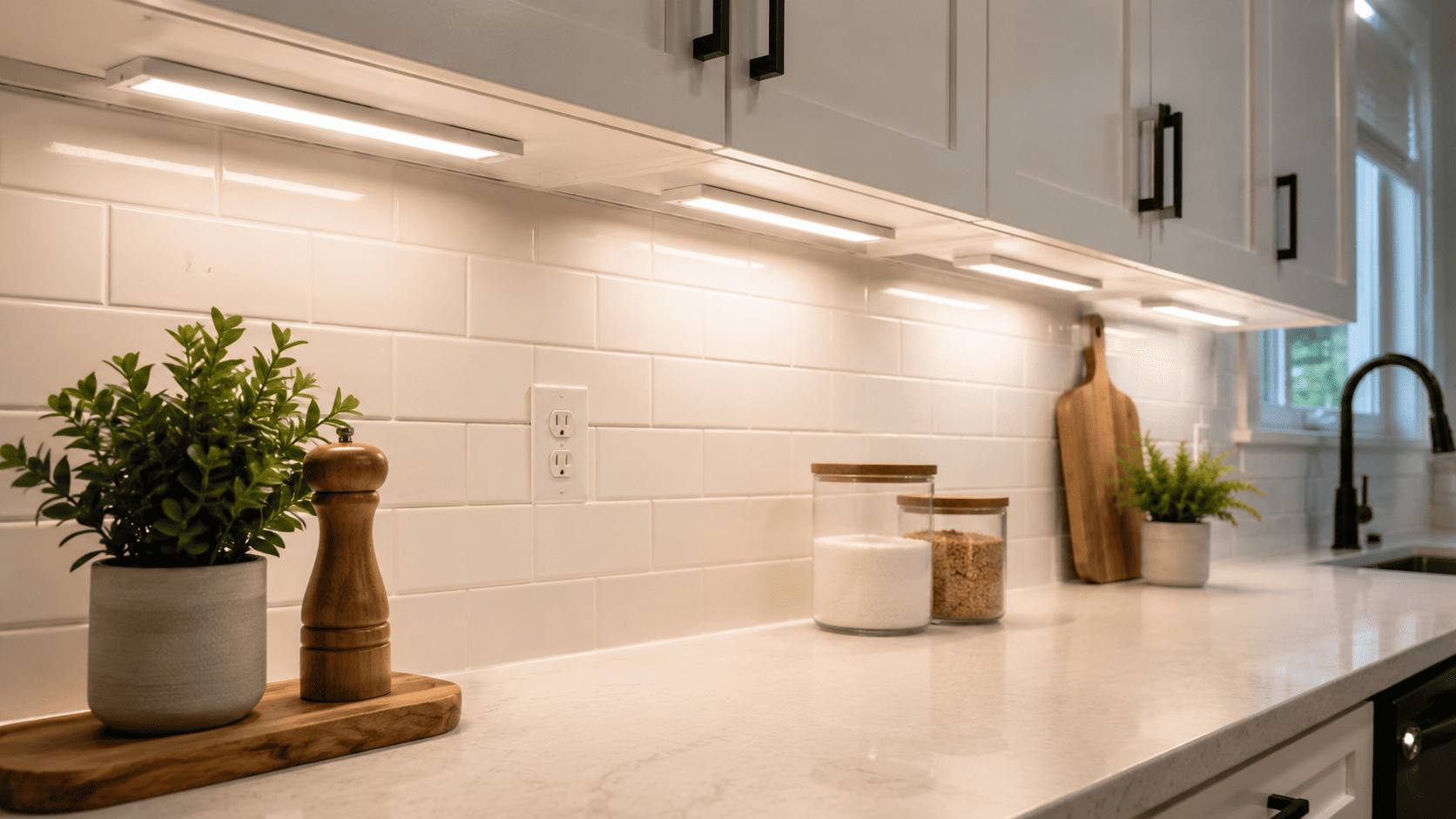
Their main advantages include:
- Straightforward installation
- Consistent light output
- Integrated housing and diffuser
- Good suitability for retrofit projects
- Easier replacement than recessed systems
The main limitation is fixture visibility. Because the bar has a fixed housing, it may be noticeable from nearby seating areas or from a lower viewing angle.
A cabinet light valance can help conceal the fixture. Without a valance, the bar should be selected carefully so its depth does not extend below the cabinet edge.
For rental properties and multifamily renovations, LED bars can offer a practical balance between installation speed, cost and lighting performance.
2.3. LED Puck Lights
Puck lights are small circular or square fixtures that produce a focused pool of light. They can be surface-mounted or recessed into a cabinet panel.
They are commonly used inside:
- Glass-door cabinets
- Display cabinets
- Open shelving
- Small countertop sections
- Bar or beverage areas
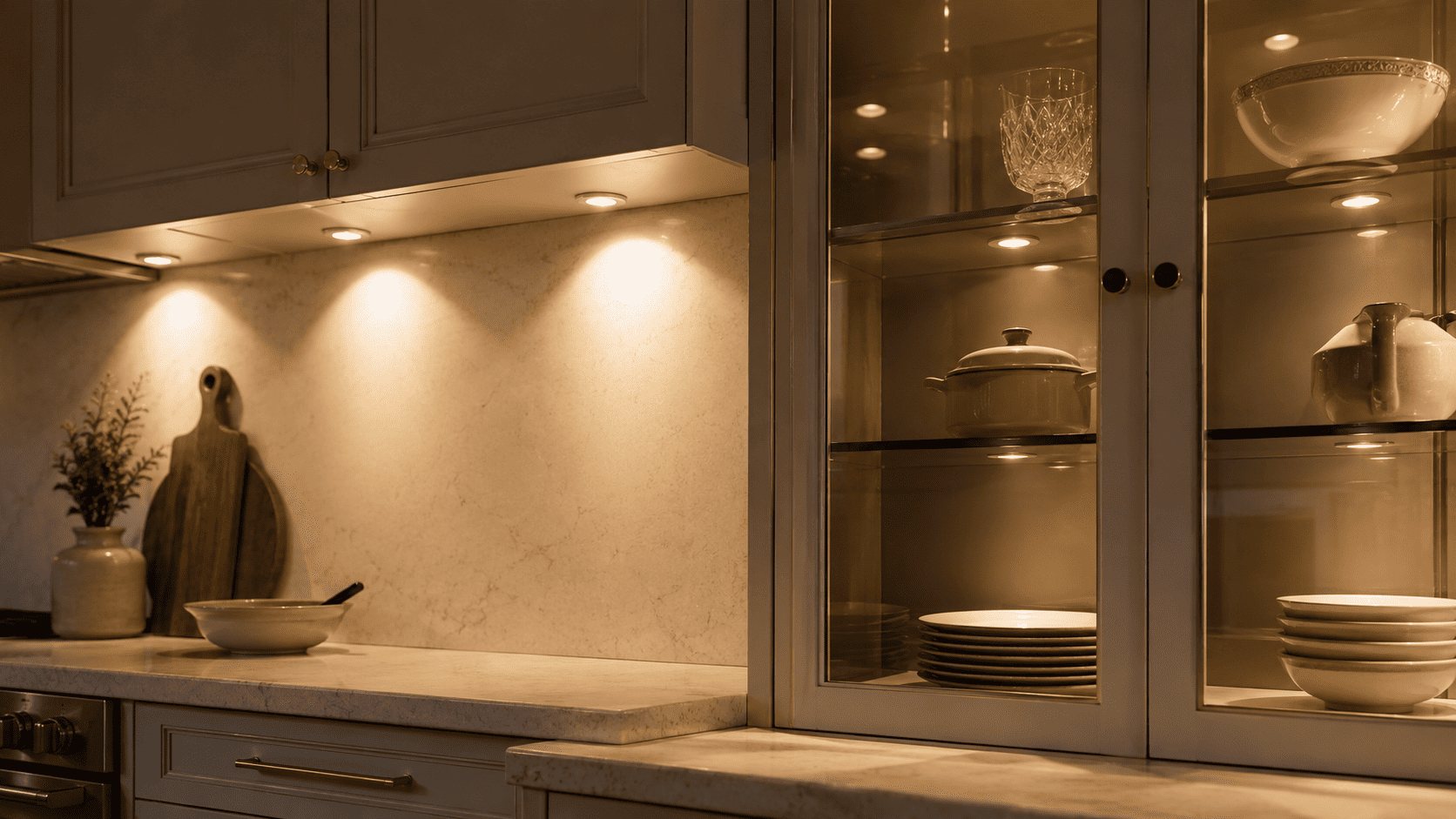
Puck lights provide a more decorative effect than continuous task lighting. They work well when the goal is to highlight a particular cabinet section or object.
When used under kitchen cabinets, the spacing must be planned carefully. If the lights are too far apart, the countertop may show alternating bright and dark areas. This can make the surface look uneven and may reduce task visibility.
Puck lights are therefore more suitable for accent lighting than for long, continuous countertop runs.
2.4. Recessed Lights for Kitchen Cabinets
Recessed lights are installed partially or completely inside the cabinet panel. Only the trim, lens or light opening remains visible after installation.
Recessed lights for kitchen cabinets can create a clean, architectural appearance, especially in custom kitchens where lighting details are coordinated during the design stage.
They may be used:
- Under upper cabinets
- Inside glass-door cabinets
- Above open shelves
- Inside cabinet niches
- In custom display units
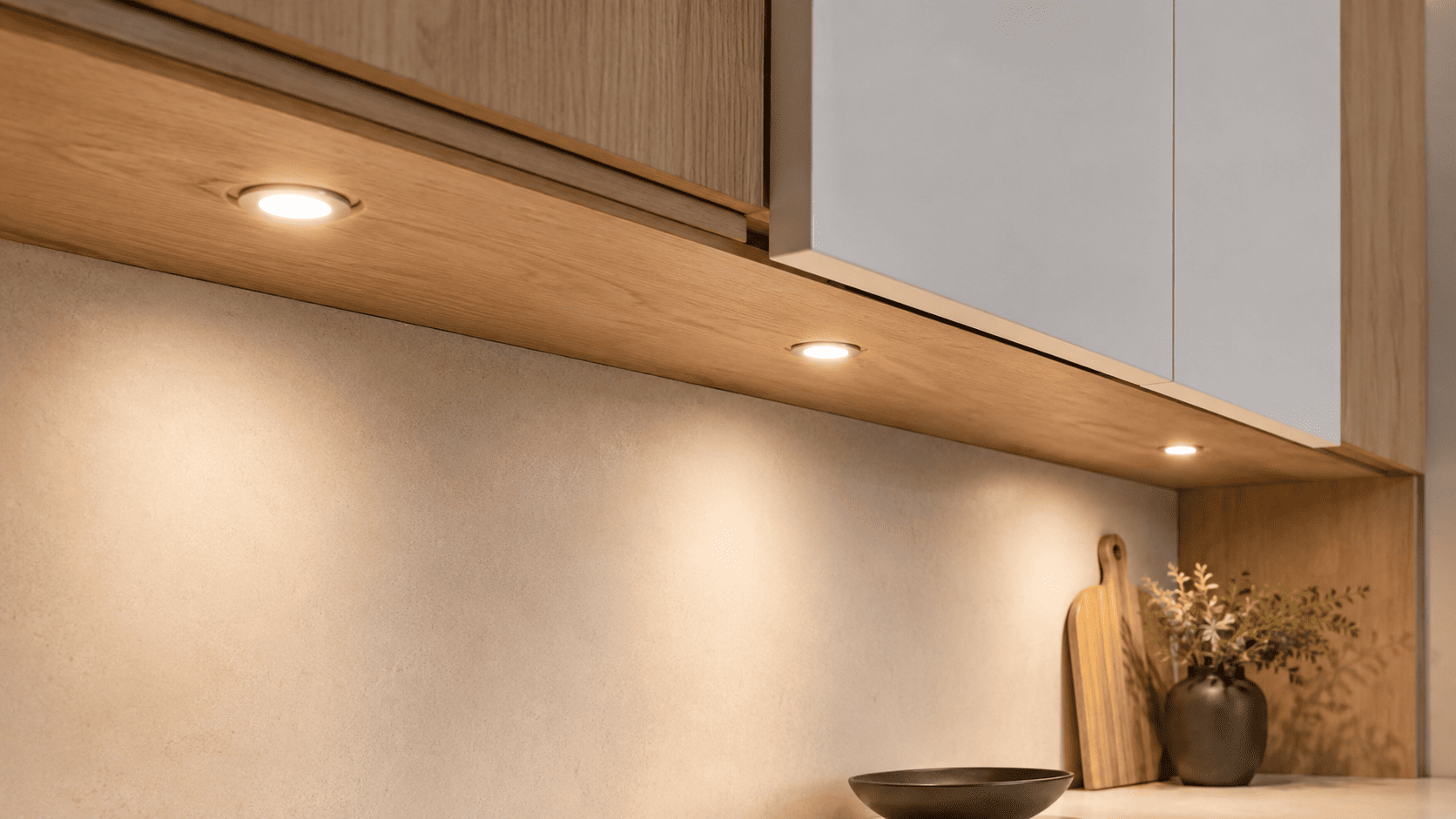
The installation requires more preparation than a surface-mounted fixture. The cabinet manufacturer or installer must know the fixture diameter, recess depth, wiring requirements and required clearance.
If the cabinet bottom panel is too thin, an additional panel or modified cabinet construction may be necessary. For this reason, recessed lighting should ideally be specified before the cabinet shop drawings are approved.
3. Comparison of LED Kitchen Cabinet Lighting Options
The table below compares the most common cabinet LED lighting systems.
| Lighting type | Light pattern | Installation level | Fixture visibility | Best application | Relative cost |
| LED tape | Continuous and even | Moderate | Very low when recessed | Modern kitchens, long countertop runs and new cabinets | Medium |
| LED light bar | Continuous | Easy to moderate | Medium | Existing kitchens and retrofit projects | Low to medium |
| LED puck light | Focused | Easy to moderate | Low | Display cabinets and accent lighting | Medium |
| Recessed light | Focused or diffused | More complex | Very low | Custom cabinet projects and integrated designs | Medium to high |
For most new kitchens, LED tape installed inside an aluminum channel provides the most flexible and visually consistent solution.
For existing cabinets, an LED light bar may be easier to install because it does not always require routing a channel into the cabinet panel.
Puck lights are better for decorative lighting, while recessed fixtures are appropriate when the project requires a fully integrated appearance.
The final selection should also account for maintenance. A highly concealed system may look cleaner, but drivers, connectors and wiring should still remain accessible.
For a more detailed comparison of brightness, controls, fixture sizes and installation options, read our complete guide to the best kitchen under cabinet lighting.
4. Key Technical Factors to Consider Before Installation
Selecting the fixture is only the first step. The color temperature, color rendering, power supply and placement can all change how the finished kitchen looks.
4.1. Choose the Right Color Temperature
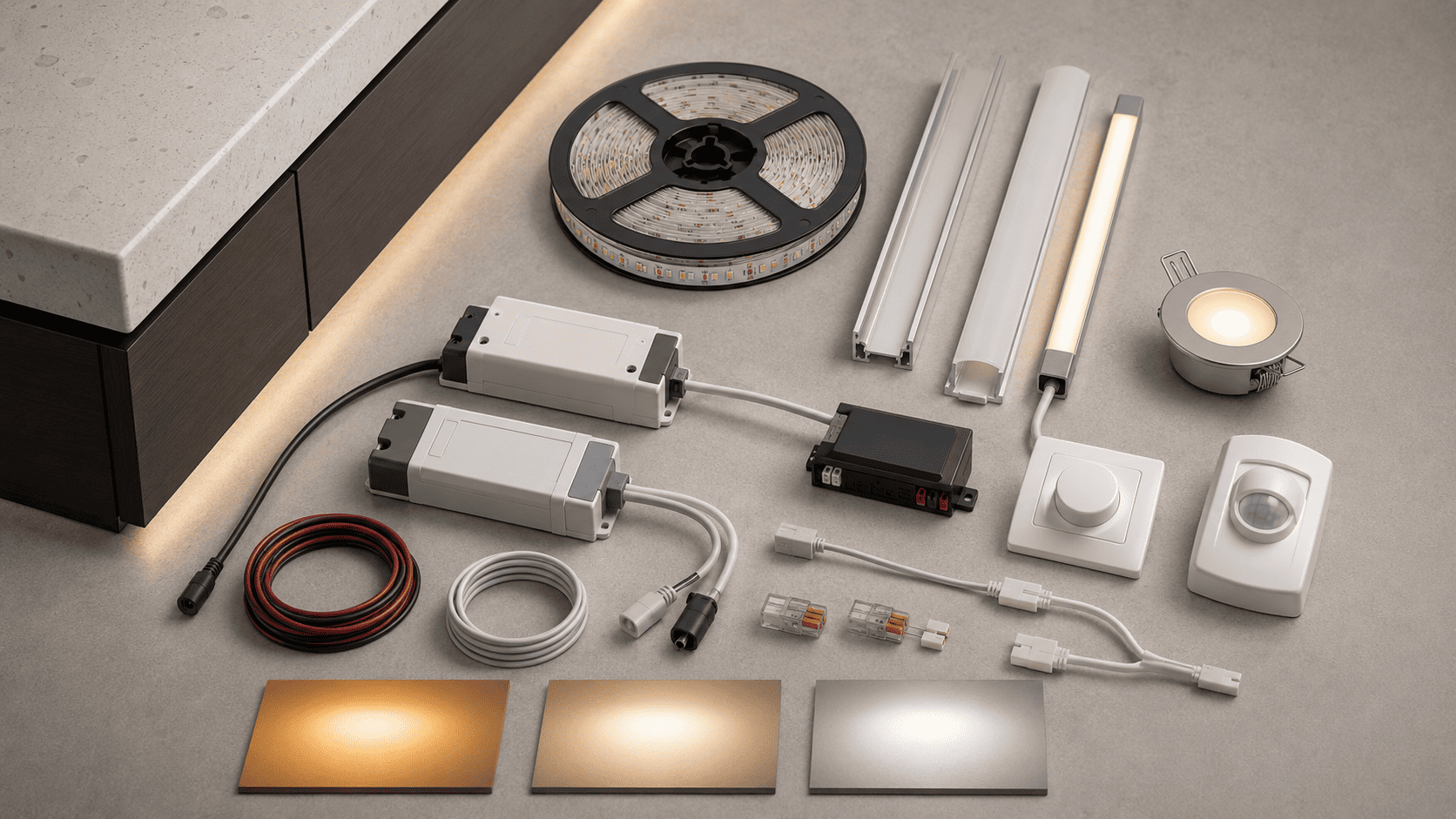
Color temperature is measured in Kelvin and affects whether the light appears warm, neutral or cool.
2700K produces warm light with a slightly yellow appearance. It works well in traditional kitchens and spaces with warm wood finishes.
3000K provides a balanced warm-white tone. It is suitable for many residential kitchens and works with painted cabinets, white oak, walnut and neutral finishes.|
4000K creates a cooler, brighter appearance. It can improve task visibility but may feel less comfortable in kitchens designed with warm colors.
>>> Warm white lighting around 2700K to 3000K can enhance the natural grain and tone of light wood kitchen cabinets without making the finish appear too yellow or washed out.
The light should be evaluated together with the cabinet finish, backsplash and countertop. A cabinet color that looks neutral under daylight may appear warmer or cooler under a different LED temperature.
Using one consistent color temperature throughout the kitchen is also important. Mixing a 2700K ceiling light with 4000K under-cabinet lighting may create an unbalanced appearance.
4.2. Look for a CRI of 90 or Higher
The Color Rendering Index, or CRI, indicates how accurately a light source displays colors compared with natural light.
For kitchens, a CRI of 90 or higher is generally preferable because lighting affects how people see:
- Food colors
- Painted cabinet finishes
- Wood grains
- Quartz and natural stone patterns
- Backsplash materials
Low-quality lighting can make food look dull and may change the perceived tone of the cabinets. This is particularly noticeable with white, cream, gray, green and natural wood finishes.
For display kitchens, showrooms and higher-end residential projects, color consistency between fixtures should also be considered. Two LED products with the same listed color temperature may still appear slightly different if they come from different production batches or manufacturers.
4.3. Hardwired, Plug-In or Battery-Powered
A hardwired system connects directly to the electrical circuit. It offers a clean appearance because the power cable can be concealed, but it requires electrical planning and professional installation.
A plug-in system connects to a nearby outlet. It is easier to add to existing cabinets, although the cord and outlet location may remain visible.
Battery-powered under kitchen cabinet LED lights require little wiring, but batteries need to be replaced or recharged. They are usually better for small areas, temporary use or cabinets where electrical access is limited.
For full kitchen installations, hardwired systems normally provide the most integrated result. Plug-in systems are often more practical for retrofits.
Control options may include:
- Wall switches
- Dimmers
- Motion sensors
- Touch sensors
- Cabinet door sensors
- Smart home controls
The control method should be confirmed early because it affects wiring, driver selection and installation responsibilities.
4.4. Compare 12V and 24V Systems
Many LED tape and low-voltage cabinet lighting systems operate at either 12V or 24V DC.
A 12V system may be suitable for short lighting runs and smaller installations. A 24V system is often preferred for longer runs because it can help reduce voltage drop and maintain more consistent brightness.
The driver must match the voltage of the LED system. It should also provide enough capacity for the total wattage of the connected fixtures.
For example, the driver should not be selected only according to the exact calculated wattage. The installer should follow the lighting manufacturer’s loading recommendations and allow appropriate capacity for safe operation.
Driver placement is equally important. It should be concealed but still accessible for replacement, inspection and ventilation.
4.5. Position the Lights Correctly
Fixture placement has a major effect on countertop illumination.
For most under-cabinet applications, placing the light closer to the front edge of the upper cabinet helps distribute light across the main working area. If the fixture is installed too close to the wall, it may illuminate the backsplash strongly while leaving the front of the countertop darker.
The correct position depends on:
- Cabinet depth
- Fixture beam angle
- Countertop depth
- Backsplash reflectivity
- Presence of a light valance
- Distance between the cabinet and countertop
Glossy countertops and backsplashes may also reflect the fixture. A diffuser and recessed installation can help reduce glare and visible LED points.
The lighting position should be tested using an actual fixture whenever possible, particularly for custom kitchens with reflective materials.
5. How Cabinet Construction Affects Lighting Choices
Cabinet design determines whether the lighting can be recessed, concealed and connected continuously across multiple cabinet boxes.
5.1. Frameless vs Framed Cabinet Integration
Frameless cabinets can make it easier to create a continuous lighting line because the cabinet box does not have a face frame extending across the front.
However, the installer still needs to consider the joints between individual cabinet boxes. Wire access holes or connectors may be required to continue the lighting across each unit.
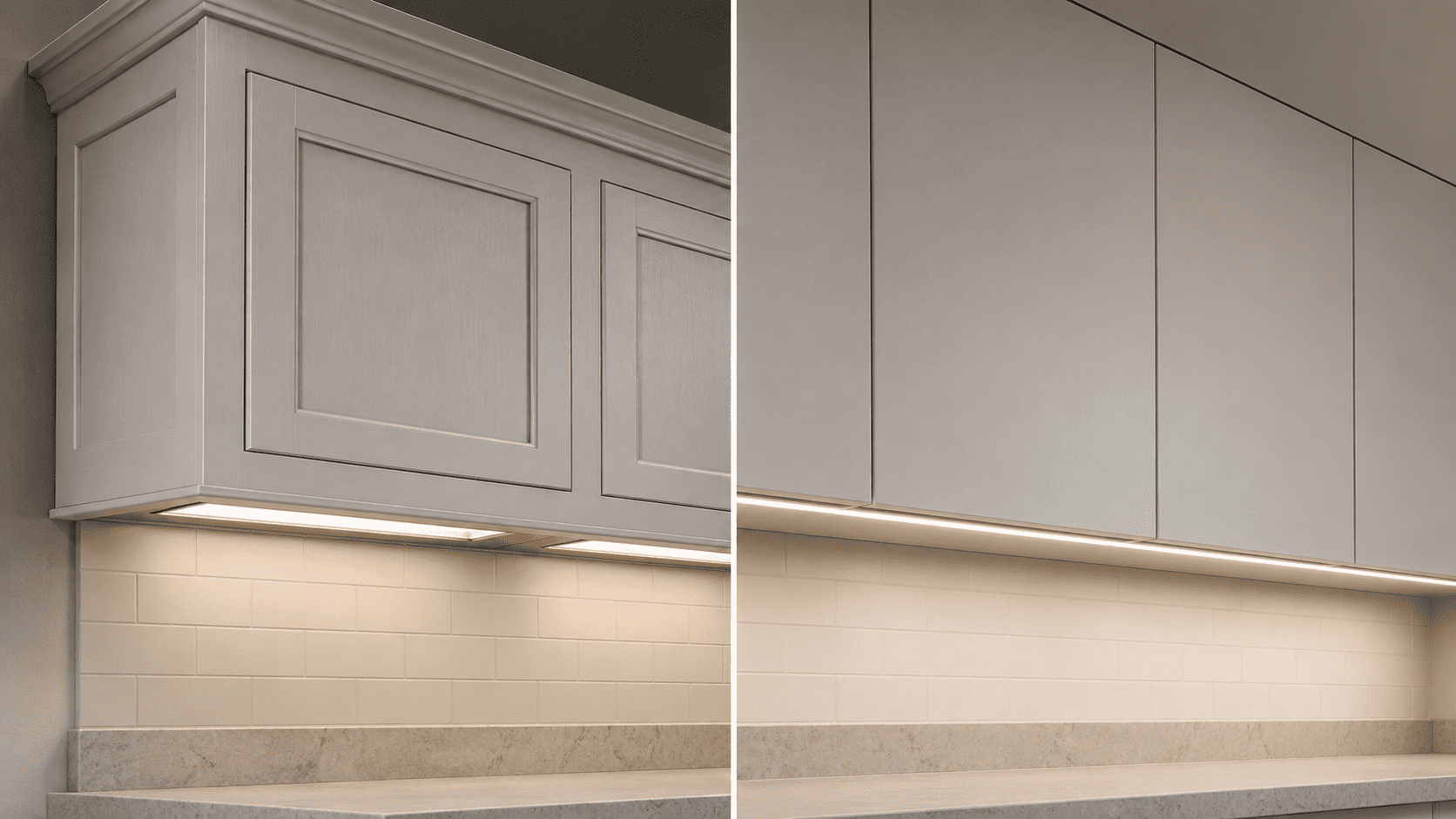
Framed cabinets include a face frame around the cabinet opening. Depending on the design, the frame may help conceal the fixture, but it can also interrupt recessed channels or wiring routes.
For both cabinet types, lighting details should be reviewed with the cabinet elevations and sections rather than added after production without coordination.
5.2. Bottom Panels, Channels and Light Valances
Several cabinet construction details can improve the final lighting result.
A recessed aluminum channel allows LED tape to sit partially or fully inside the bottom panel. This creates a low-profile appearance and helps manage heat.
A false bottom panel can provide additional space for wiring and recessed fixtures without exposing components inside the cabinet.
A light valance extends below the front edge of the upper cabinet and hides surface-mounted bars or strips from view.
Wire access holes allow cables to pass between cabinets or reach a concealed driver.
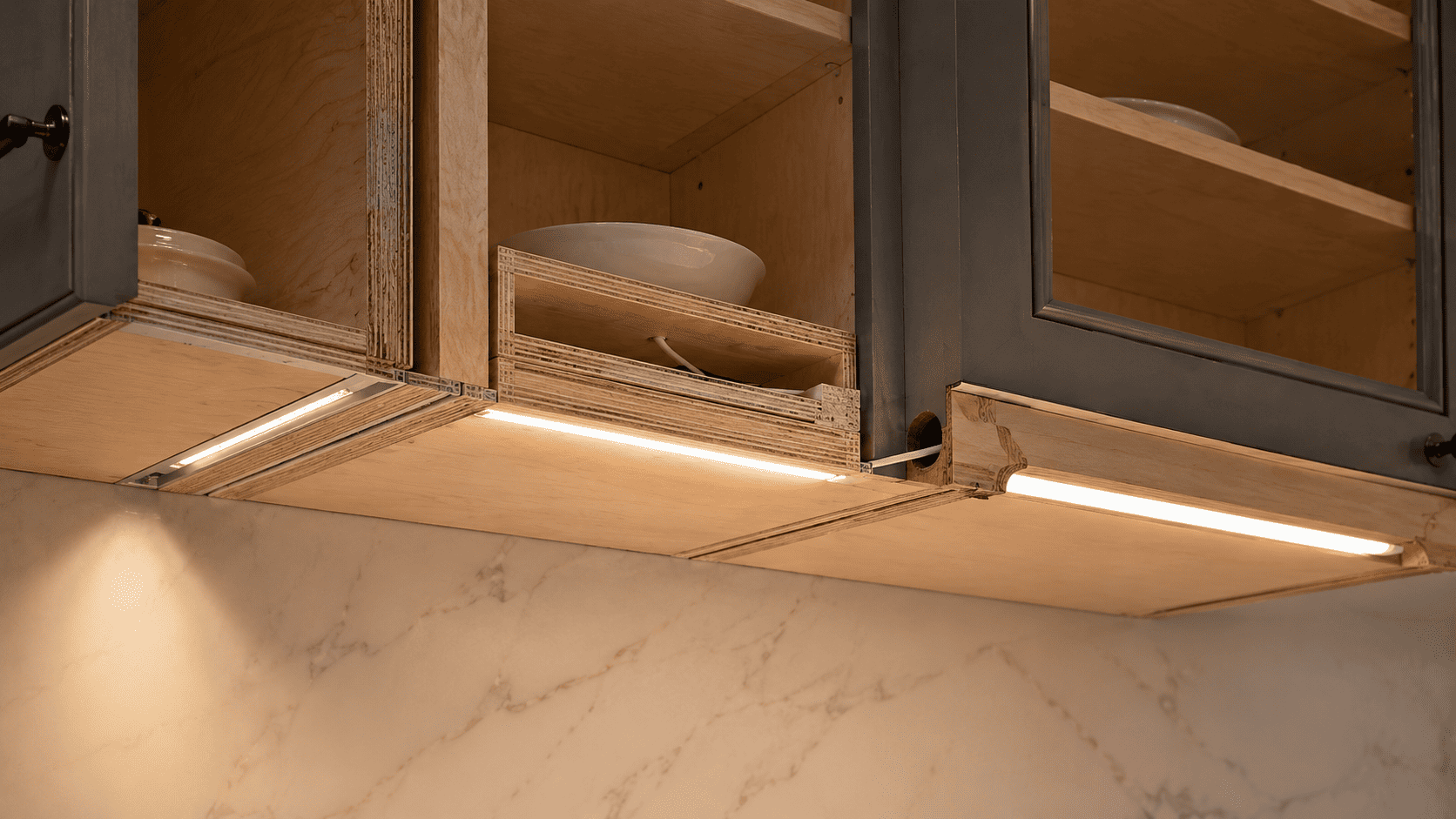
These details affect cabinet dimensions and machining. They should therefore be included in the shop drawings whenever the cabinet factory is expected to prepare the lighting locations.
5.3. What to Confirm Before Cabinet Production
For new cabinet projects, the following information should be confirmed before production begins:
- Lighting type and manufacturer
- Fixture or channel dimensions
- Recessed depth
- Voltage and total wattage
- Driver dimensions and location
- Wiring route
- Switch, dimmer or sensor type
- Required access holes
- Cabinet sections receiving lighting
- Factory preparation and onsite installation responsibilities
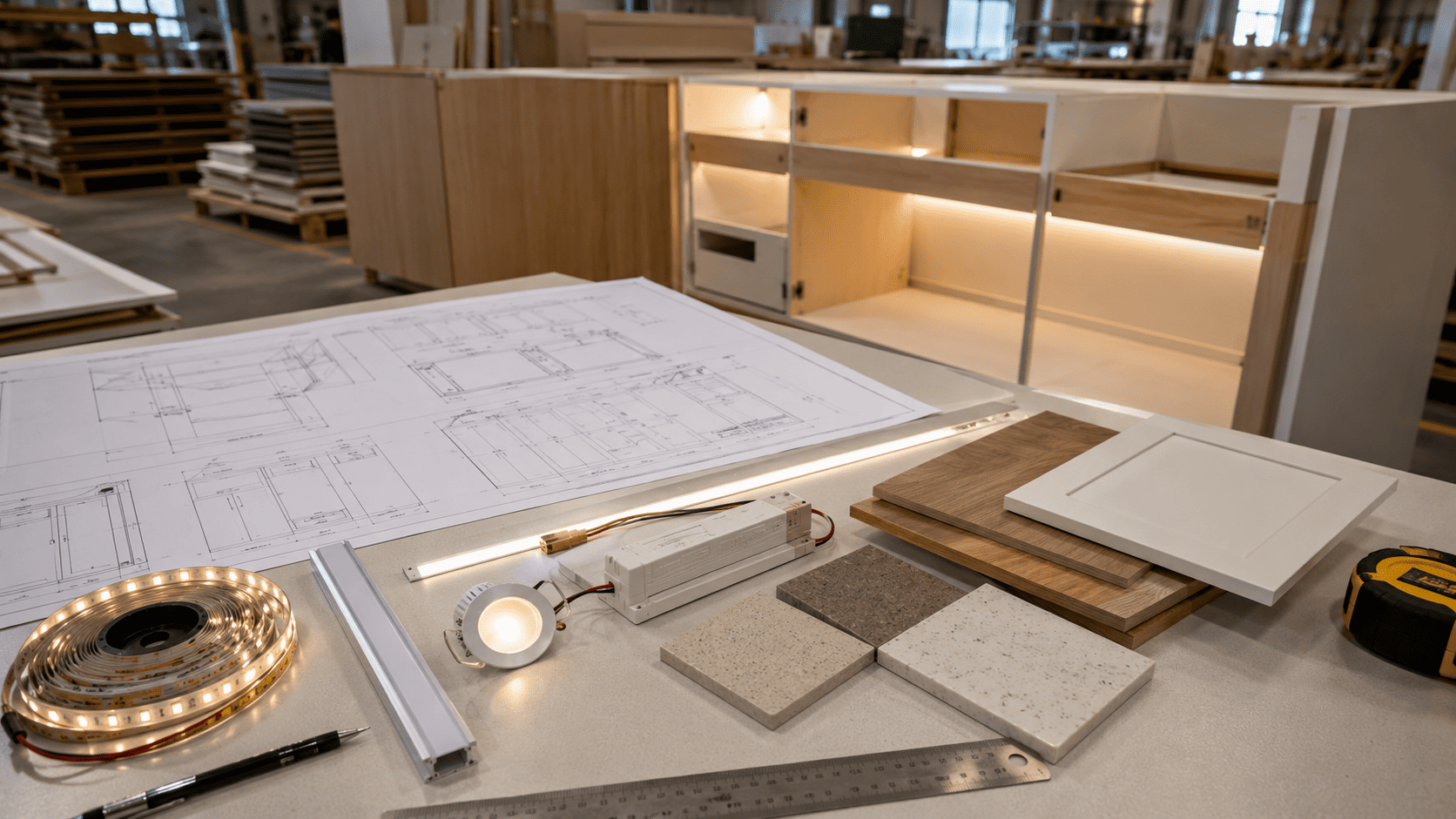
Lighting should not be specified only as a general note such as “provide under-cabinet LED lights.” The cabinet team needs actual fixture information to prepare channels, holes and clearances accurately.
For multifamily and hospitality projects, repeatable lighting details are particularly important. Using one approved configuration across all units helps reduce onsite adjustments and inconsistent installation.
Lighting channels, wiring access and fixture clearances should be coordinated with an experienced cabinet supplier. Learn more about VIC Cabinet’s manufacturing capabilities in our guide to Vietnam cabinet manufacturers.
Conclusion
The best LED kitchen cabinet lighting system depends on the cabinet design, project stage and desired lighting effect.
LED tape is a strong choice for continuous lighting and integrated cabinet designs. LED bars are practical for retrofit installations. Puck lights work well for display areas, while recessed fixtures provide a clean appearance for custom cabinetry.
Regardless of the fixture type, the project team should confirm the color temperature, CRI, voltage, driver location, wiring route and cabinet preparation before installation begins.
For custom and multifamily cabinet projects, VIC Cabinet can coordinate lighting-related cabinet details during the shop drawing stage, including recessed channels, light valances, wire access holes and modified bottom panels based on the approved fixture specifications.
VIC CABINET – Vietnam cabinet manufacturer
Head Office: Tran Thu Do Street, Hoang Liet, Hoang Mai District, Hanoi, Vietnam
HCM Office: N8 Street, Phu Thuan, District 7, Ho Chi Minh City, Vietnam
Phone: +84 96 781 7316
Website: https://viccabinet.com
Email: info@viccorp.com.vn
