


To successfully import kitchen cabinets into the United States without customs delays or unexpected margin erosion, businesses must navigate federal anti-dumping regulations, secure formal chemical emissions compliance, and optimize container packing volumes. Transitioning from middleman trading brokers to verified Southeast Asian manufacturing facilities allows large-scale cabinet import companies to achieve long-term pricing and structural supply chain stability.
1. Sourcing Matrix: Choosing the Right Origin for Your Cabinet Import Business
1.1. China vs. Vietnam: Navigating Anti-Dumping (AD) and Countervailing Duties (CVD)
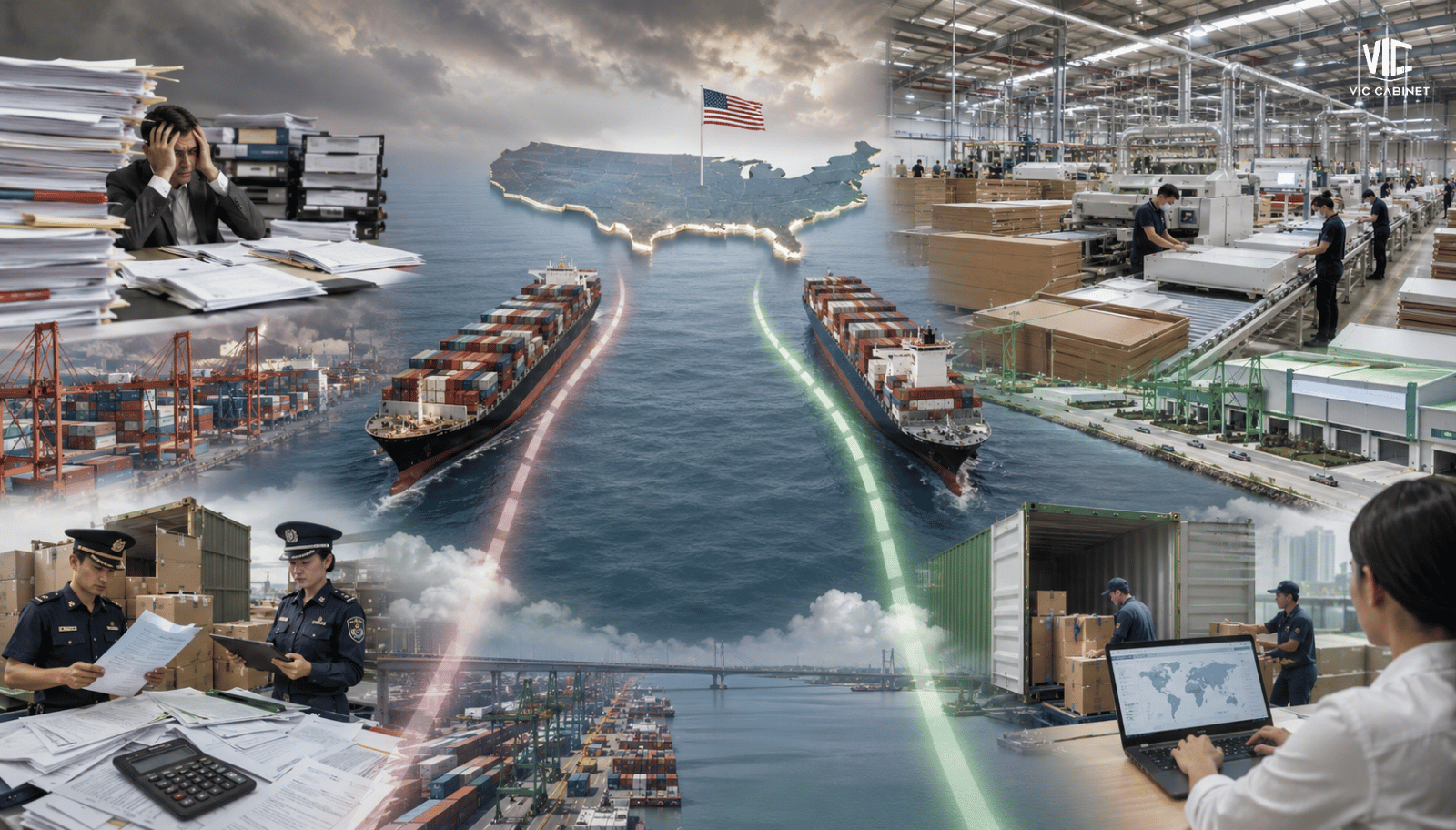
The global supply chain landscape for any high-volume cabinet importer shifted drastically following the US Department of Commerce (DOC) rulings on wooden cabinets and vanities. Imposing heavy anti-dumping and countervailing duties on Chinese origins forced major cabinet importers USA to re-evaluate their regional sourcing matrix.
Sourcing from China now carries massive financial penalties, often exceeding 250% in combined duties. Conversely, Vietnam has emerged as the premier alternative hub for international procurement. Importers utilizing Vietnamese manufacturing networks avoid these prohibitive trade barriers, allowing commercial distributors to preserve their baseline gross margins.
1.2. Factory-Direct Manufacturers vs. Third-Party Trading Companies
Many cabinet import companies source products through trading brokers instead of working directly with manufacturers. Brokers often offer lower minimum order requirements. However, this approach can create supply chain complexity, increase pricing layers, and reduce visibility into product quality and consistency.
Partnering directly with an established factory eliminates hidden markups and grants direct oversight of production schedules. For volume distributors handling multi-family construction or retail distribution networks, factory-direct communication ensures that technical modifications are executed accurately on the assembly line, avoiding systemic batch errors.
2. Financial Risk Mitigation: Navigating Tariffs and Landed Cost Calculations
Evaluating a potential manufacturing partner requires moving past simple Free On Board (FOB) price sheets to calculate true landed costs. A miscalculated shipping budget can quickly turn a profitable commercial container into an operational loss.
Landed Cost = FOB Price + Ocean Freight + Customs Duties + Port Handling + Local Logistics
A comprehensive landed cost assessment must factor in:
- Customs Brokerage and Entry Fees: Standard processing fees for legal entry clearance at US ports of entry.
- Harbor Maintenance and Cargo Fees: Federal taxes calculated as a strict percentage of the overall cargo value.
- Demurrage and Detention Tariffs: Daily penalties incurred when containers sit at port terminals past their designated free-time window.
To maintain stable capital allocations, large-scale cabinet import companies establish structured logistics agreements that outline exact financial responsibilities prior to port departure.
3. Controlling Material Integrity: Compliance and Chemical Regulations
3.1. Formaldehyde Emissions: Securing CARB Phase 2 and TSCA Title VI Clearance
Every kitchen cabinet importer entering the US market faces strict scrutiny regarding indoor air quality and chemical compliance. The Environmental Protection Agency (EPA) strictly enforces Toxic Substances Control Act (TSCA) Title VI regulations alongside California Air Resources Board (CARB) Phase 2 mandates.
Maximum Allowed Formaldehyde Emissions:
– Hardwood Plywood (HWPW): 0.05 ppm
– Medium-Density Fiberboard (MDF): 0.11 ppm
Imported components must carry clear compliance stamps on every finished box layer. Importing uncertified engineered wood substrates risks total container seizure by US Customs and Border Protection, accompanied by severe federal administrative fines.
3.2. Structural Adhesion: Meeting KCMA Structural Performance Metrics
To compete successfully in the domestic multi-family development space, imported products should align with the Kitchen Cabinet Manufacturers Association (KCMA) performance standards. These guidelines require rigorous stress testing of the physical cabinet box structure.
Tops, bottoms, and structural shelving must withstand sustained weight distribution without localized bowing or joint separation. Ensuring your offshore production plant uses high-tensile fasteners and industrial-grade wood glues prevents catastrophic structural failures during localized high-volume job-site installations.
3.3. Moisture Content Management: Preventing Plywood Warping in Cold Climates
A frequent problem when you import kitchen cabinets from humid tropical regions into cold North American climates is severe wood warping. Extreme shifts in relative atmospheric humidity cause unstable timber substrates to expand or contract violently.
Industrial factories counteract this issue by strictly monitoring the equilibrium moisture content (EMC) of raw timber cores throughout the milling cycle. Maintaining a controlled internal moisture level between 6% and 9% guarantees that the finished wood components remain structurally straight and square after arrival in low-humidity US distribution regions.
3.4. Coating Resilience: Ensuring UV and PU Finish Longevity Under High Traffic
Surface finish failures represent a major source of warranty claims for volume distributors. Kitchen environments subject cabinet faces to constant impact, grease accumulation, and chemical cleaning agents.
Production lines must utilize multi-layer Polyurethane (PU) or Ultraviolet (UV) cured coating systems. These advanced automated finishing lines create an impenetrable cross-linked molecular barrier that resists color fading, scratch marks, and moisture delamination along critical door edges.
4. Volumetric Efficiency: RTA vs. Fully Assembled (FA) Freight Math
Optimizing container space utilization directly dictates final profitability margins. Importers must choose between Ready-to-Assemble (RTA) flat-packs and Fully Assembled (FA) cabinetry structures based on total landed shipping configurations.
| Logistic Variable | Ready-to-Assemble (RTA) | Fully Assembled (FA) |
| Units Per 40ft HQ Container | 700 to 800 flat-packed units | 200 to 250 built-up boxes |
| Ocean Freight Cost Per Unit | $6.25 – $8.50 per unit | $22.00 – $28.00 per unit |
| Domestic Warehouse Footprint | Minimal (High stack density) | Substantial (Air volume loss) |
| On-Site Labor Overhead | High (Requires field assembly) | Low (Immediate installation) |
RTA shipments maximize container space utilization and reduce freight costs per SKU. Fully assembled cabinets remain a preferred option for fast-track commercial projects. They help minimize on-site installation time in regions with high labor costs.
5. Operational Pitfalls: Batch Inconsistency and Phased Job-Site Logistics
The most critical operational failure for an active distributor is receiving mismatched finishes across different delivery phases. When a multi-unit project requires staggered shipments over several months, minor variations in wood grain base tones or paint mixing ratios create noticeable color deviations on-site.
Professional manufacturers solve this problem by deploying digital spectrophotometers to analyze and lock down exact Delta E (ΔE) color consistency matrix parameters across every single production run. Furthermore, the factory maintains physical “master samples” from the initial approved prototype to serve as an unalterable benchmark for all subsequent container runs.
6. Establishing Technical Frameworks with Manufacturing Partners
Preventing structural manufacturing errors requires implementing an ironclad pre-production engineering review protocol. Importers must never authorize mass assembly based on basic conceptual sketches or manual architectural floor plans.
[Architectural Plan] ➔ [Detailed 2D Shop Drawing] ➔ [3D CNC File Conversion] ➔ [Physical Master Prototype]
Every product specification must be translated into accurate technical shop drawings detailing precise millimeter measurements. These metric dimensions are directly programmed into automated computer numerical control (CNC) machining centers. This automated workflow maintains tight manufacturing tolerances within ±0.5mm, ensuring seamless modular component integration during final on-site installation.
7. Why More Cabinet Importers Are Sourcing from Vietnam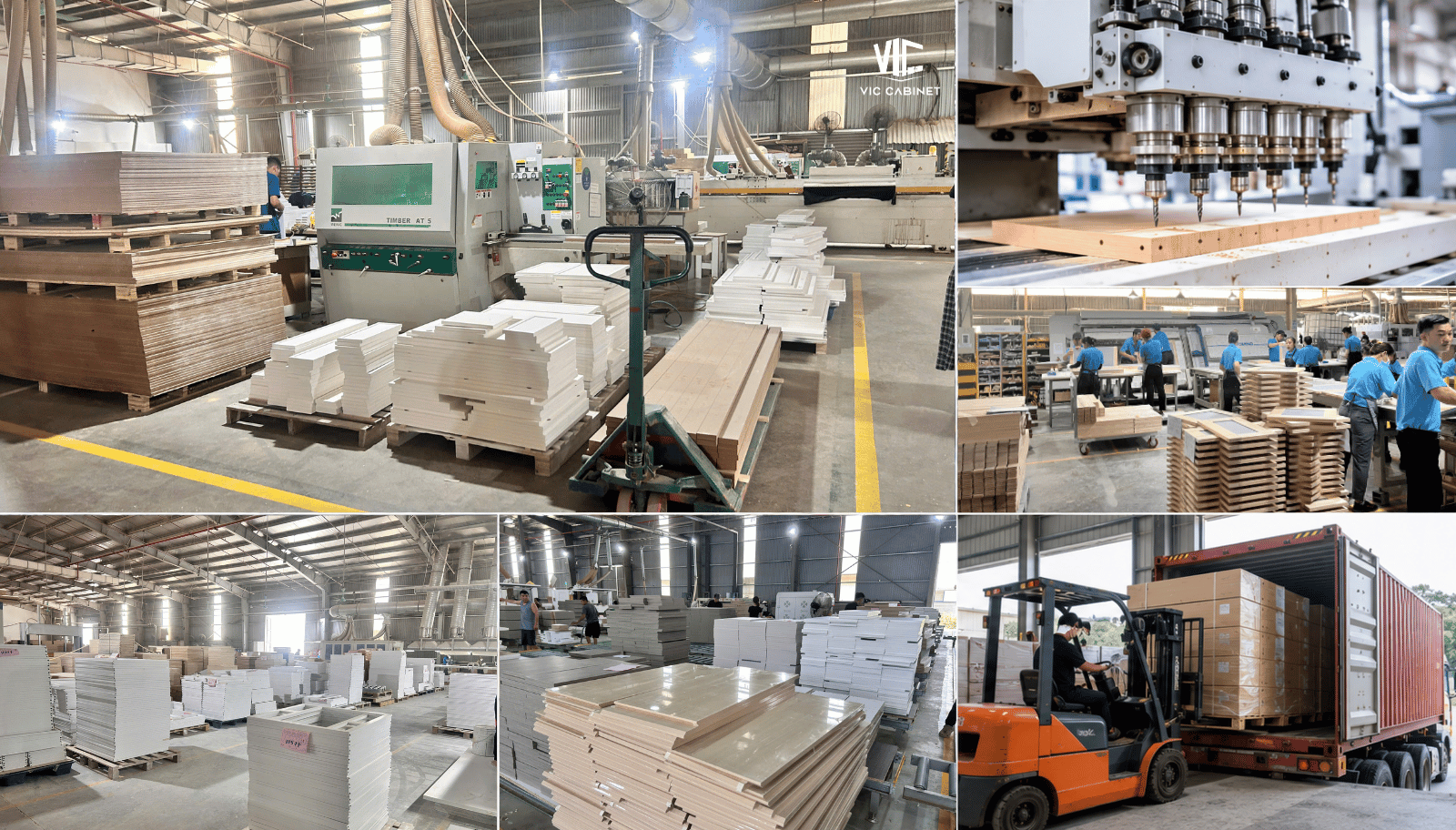
7.1. Infrastructure, Tariff Exemptions, and Trade Corridors to the USA
Vietnam has become a major global manufacturing hub. Large-scale investments in deep-water seaports have expanded export capacity. International trade agreements have strengthened access to overseas markets. Major ports such as Haiphong and Cat Lai provide direct shipping routes to the United States. These routes support predictable transit times to both East Coast and West Coast destinations. More importantly, stable geopolitical frameworks and exemptions from punitive US trade tariffs provide long-term supply chain security for multi-year commercial contract allocations.
7.2. Production Capabilities at the VIC Cabinet Factory
For major importers requiring scalable volume, VIC Cabinet Factory delivers a streamlined, factory-direct OEM production environment. Operating from centralized Vietnamese industrial facilities, VIC Cabinet specializes in container-level export logistics designed to feed large-scale US distribution channels.
VIC Cabinet Material Matrix:
– Plywood (High-density multi-layer structural cores)
– MDF & MFC (Precision-milled composite substrates)
– Solid Wood (Premium natural timber face frames)
– Advanced Finishes (Automated UV, PU, & Acrylic overlays)
By controlling every phase of manufacturing within a single unified production ecosystem, VIC Cabinet ensures rigorous compliance with US regulatory bodies while providing flexible private-label customization. Their team handles complex structural specifications, ranging from standard shaker kitchen lines to ADA-compliant bathroom vanities, maximizing container loading configurations to minimize land-based freight overhead for the end importer.
FAQ
1, What are the standard minimum order quantities (MOQ) for factory-direct cabinet imports?
Most established Southeast Asian manufacturers require a minimum order of one 40-foot High Cube (HQ) container. This volume typically accommodates around 750 flat-packed RTA cabinet units or 220 fully assembled cabinet boxes. The requirement helps optimize ocean freight costs and supports efficient factory operations. It also allows automated CNC production lines to maintain standardized output without costly changeovers between manufacturing runs.
2, How long is the typical production and transit lead time for US deliveries?
The standard factory production cycle requires 4 to 6 weeks from final shop drawing sign-off to container sealing. Maritime transit across global ocean shipping lanes adds approximately 25 to 35 days for US West Coast arrivals and 40 to 45 days for US East Coast terminals. Importers should plan for a total rolling lead time of 75 to 90 days to safely accommodate customs processing and local inland logistics.
3, How can a US importer verify chemical compliance before cargo departure?
Importers must require their manufacturing partner to supply valid, third-party laboratory test reports demonstrating full compliance with TSCA Title VI and CARB Phase 2 standards. These laboratory reports should come from accredited third-party testing organizations, such as SGS, Intertek, or TÜV Rheinland. The documents should match the production batch numbers listed on the container bills of lading.
4, What steps prevent cabinet damage during extended ocean shipping transits?
Mitigating transit damage requires upgrading from standard domestic packaging to reinforced export grade boxes. All cabinet faces must be wrapped in heavy-duty polyethylene protective foam sheets, fitted with high-density molded corner protectors, and packed into multi-wall corrugated cardboard cartons. Palletized loads must be securely bound with heavy-duty plastic strapping and completely wrapped in industrial stretch film to prevent internal shifting inside the container during rough ocean transits.
