


Partnering with a factory-direct cabinet oem manufacturer in Vietnam allows US distributors and multi-family developers to bypass trading intermediaries, mitigate anti-dumping duties, and reduce procurement costs by 20% to 35%. By outsourcing to an automated production facility, American brands can scale their custom private label cabinets efficiently while maintaining strict KCMA craftsmanship and structural standards without supply chain interruptions.
1. The Strategic Value of Private Label Cabinets via Vietnam OEM
For high-volume US cabinet distributors and property developers, relying on standard wholesale trading catalogs often creates a significant business bottleneck. As a result, profit margins become more difficult to protect, while supplier-driven price increases can directly impact competitiveness. In addition, standardized product lines make it harder for brands to stand out in crowded markets. Therefore, many companies are shifting toward custom private label cabinets through direct factory partnerships. By doing so, they gain greater control over pricing strategies and long-term sourcing costs. Furthermore, private label manufacturing allows brands to develop proprietary door style configurations that competitors cannot easily replicate. Most importantly, it helps build stronger local brand equity and long-term market differentiation.
The macroeconomics of global cabinetry sourcing have shifted permanently. With the US Department of Commerce enforcing heavy anti-dumping and countervailing duties (AD/CVD) on multiple traditional manufacturing hubs, North American procurement officers require a tariff-proof alternative.
Establishing a direct contract with an experienced oem furniture factory vietnam eliminates these regulatory pricing shocks. This geographic supply chain diversification allows US wholesalers to stabilize their landed costs, lock in multi-year builder contracts, and guarantee continuous container-level inventory flow even during peak construction quarters.
2. Why US Brands Move Cabinet OEM Production to Vietnam: The Hard Data
The massive relocation of corporate supply chains to Southeast Asia is driven by clear operational math. When evaluating an oem cabinet manufacturer, North American supply chain officers rely on hard macroeconomic indicators and precise customs tariff structures to justify their multi-year manufacturing shifts.
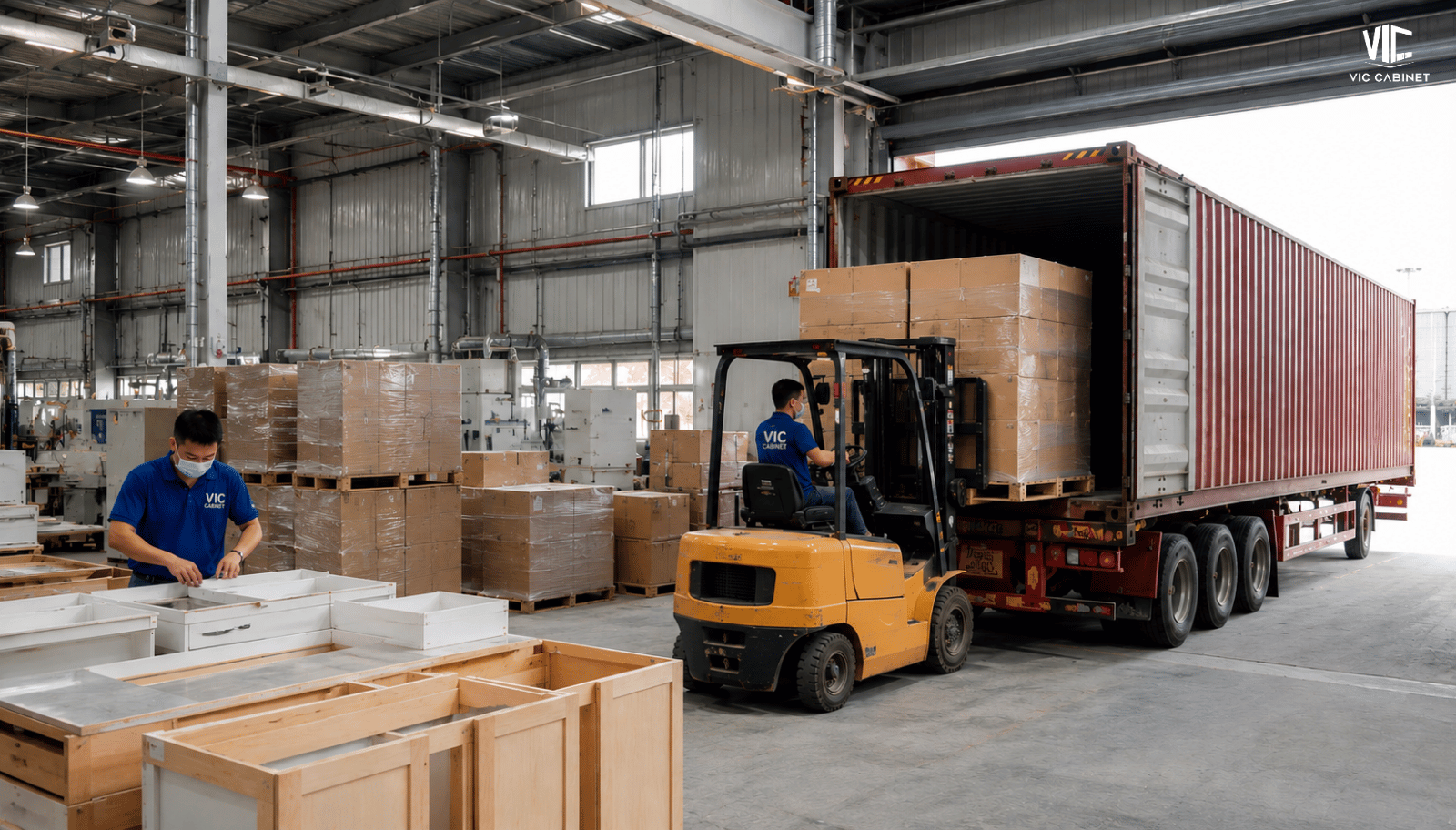
2.1, Cumulative Tariff Structures and the Chinese Sourcing Crisis
The primary catalyst for this industrial migration is the aggressive, stacked tariff landscape applied to Chinese cabinetry imports. As of June 2026, the US International Trade Commission and Customs and Border Protection enforce an intense multi-layered penalty framework on wooden cabinets and vanities originating from China.
- Anti-Dumping & Countervailing Duties (AD/CVD): Following the final results of the administrative reviews finalized in April 2026, the US Department of Commerce maintains duties ranging from 25% to 50% for sampled cooperating firms, and up to a massive 250% for all exporters falling under the China-Wide Entity rate.
- Section 232 Trade Penalties: Wooden cabinetry components and vanities face a strict 25% custom duty throughout 2026, which is statutorily mandated to escalate to 50% on January 1, 2027.
- Section 301 Statutory Tariffs: Following the Second Statutory Four-Year Review initiated by the USTR in May 2026, the List 3 trade war tariffs remain firmly locked at 25% for Chinese furniture products.
| Sourcing Tariff Matrix (June 2026) | Cabinet Sourcing from China | Sourcing from VIC Cabinet Vietnam |
| Anti-Dumping Duties (AD/CVD) | 25.00% to over 250.00% | 0.00% (Certified Local Origin) |
| Section 232 Customs Tariff | 25.00% (Rising to 50.00% in 2027) | 0.00% |
| Section 301 Trade War Tariff | 25.00% (Maintained May 2026 Review) | 0.00% |
| Total Cumulative Customs Duties | Minimum 75.00% to over 300.00% | Standard Most-Favored-Nation (MFN) Rate |
To prevent anti-circumvention penalties, VIC Cabinet enforces rigorous supply chain transparency on the factory floor. We utilize locally processed timber substrates and secure legal Certificates of Origin (C/O Form B), ensuring that all private label cabinets shipped to the US stand up to strict CBP origin audits.
2.2, Trade Volume and Vietnam Furniture Exports Growth
Data from the US International Trade Administration and global customs databases confirm Vietnam position as the leading exporter of wooden furniture to the United States market.
Vietnam routinely accounts for over 35% to 40% of all US imports of wooden bedroom and kitchen furniture, outstripping traditional European and Asian manufacturing competitors. Yearly Vietnam furniture exports to the US consistently surpass 8 billion to 9 billion USD in valuation, proving the country possesses the baseline industrial infrastructure, timber processing capacity, and deep-water shipping ports required to handle massive container-level global demand without logistical bottlenecks.
2.3, Direct Labor Cost Comparison Analysis
Cabinet manufacturing remains a labor-intensive discipline, particularly during multi-phase sanding, hand-wiping stains, and detailed quality inspections. The industrial wage gap between Western economies and Vietnam provides a definitive pricing advantage.
| Manufacturing Sourcing Region | Average Industrial Labor Cost |
| United States (Domestic Production) | $24.00 – $28.00 per hour |
| China (Traditional Export Hub) | $6.50 – $8.00 per hour |
| Vietnam (VIC Cabinet Factory Floor) | $2.50 – $3.50 per hour |
This structural labor cost optimization allows an agile oem furniture factory vietnam to absorb substantial raw material fluctuations, invest heavily in premium American-standard hardware, and still deliver finished products at a significantly lower baseline price compared to domestic fabricators.
3. Manufacturing Standards Required for an OEM Cabinet Manufacturer
Sourcing container-load volumes of oem kitchen cabinets requires moving past glossy marketing brochures. Procurement managers must evaluate a manufacturer based on verifiable material tolerances, chemical certifications, and structural quality control protocols executed on the factory floor.
3.1, Raw Material Grading and CARB Phase 2 Compliance
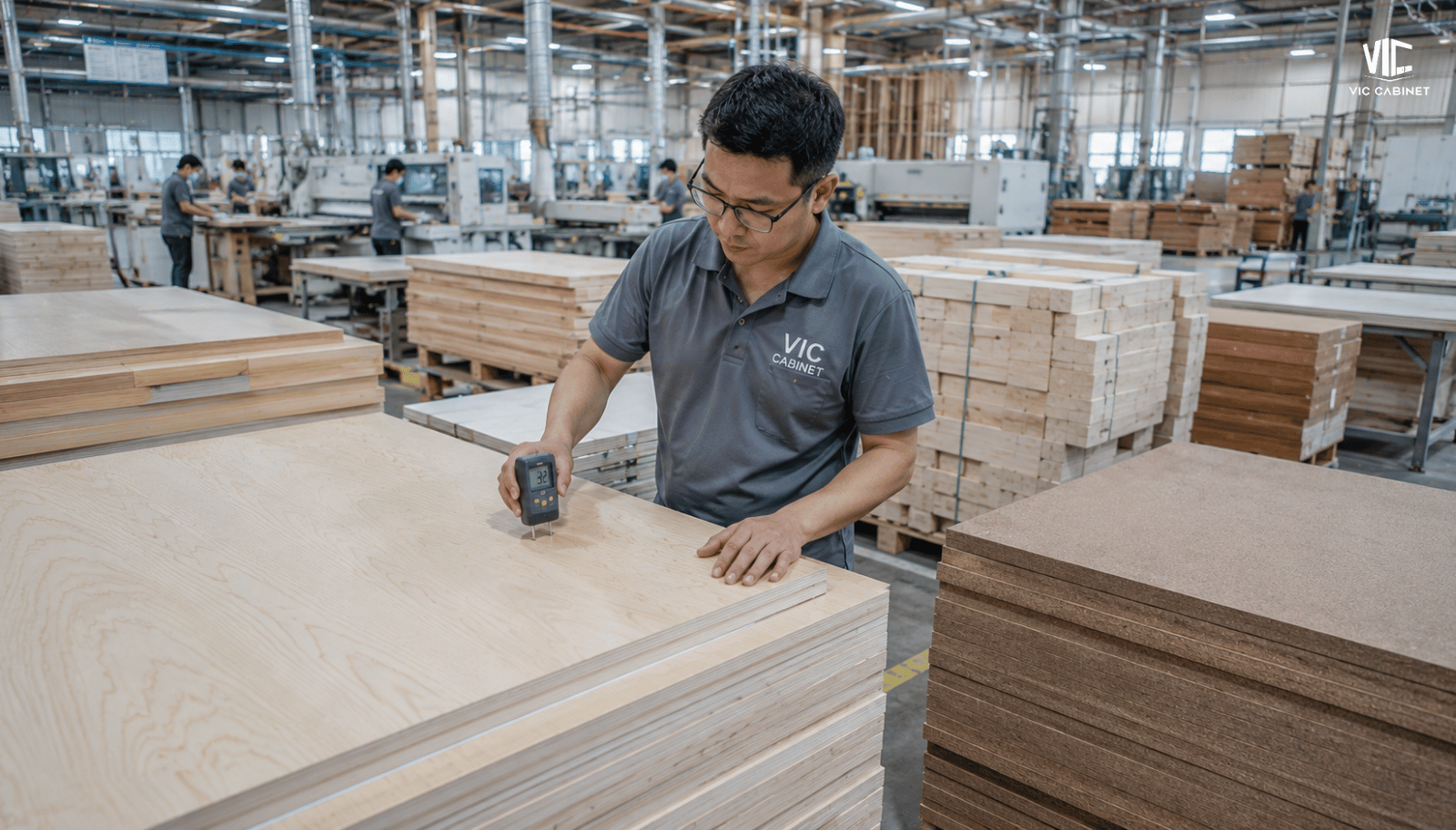
Structural failure in a residential kitchen layout almost always stems from poor material selection. US building codes and consumer safety laws demand that all engineered wood substrates comply with strict formaldehyde emission thresholds. An export-grade OEM facility must maintain third-party chain-of-custody certifications proving compliance with CARB Phase 2 and EPA TSCA Title VI regulations.
At the factory level, lumber grading must be strictly segregated by application:
- Cabinet Box Core: Must utilize 1/2-inch or 5/8-inch multi-layer birch plywood. Structural grade must be BB/CC or higher, ensuring void-free inner plies to maximize screw-holding capacity and prevent sagging under heavy granite or quartz countertops.
- Face Frames: Must consist of 3/4-inch kiln-dried solid hardwood (such as American Maple, Birch, or Oak), moisture-conditioned to an exact 6% to 8% range to eliminate post-installation warping or splitting.
- Door Panels & Drawer Fronts: For painted finishes, high-density MDF (minimum density of 750 kg/m³) must be used to provide an ultra-smooth, dimensionally stable substrate that resists cracking along rail and stile joints.
3.2, Hardware Integration and Soft-Close Mechanism Specs
An OEM factory must possess the drilling precision to integrate premium, internationally certified functional hardware. Whether the US client specifies standard hardware or requests private-label branding stamped onto the metal, the factory-installed mechanisms must meet BHMA Grade 1 performance criteria.
| Hardware Mechanical Component | Export Engineering Benchmark Specs |
| Concealed Cup Hinges | • 6-way adjustable
• 110° opening angle • Integrated hydraulic soft-close • Stamped steel construction • Tested for 50,000 cycles |
| Drawer Slide Runners | • Undermount design
• Full-extension operation • Heavy-duty concealed steel rails • Liquid soft-close dampers• Trigger-release mechanism |
| Dynamic & Static Load Ratings | • Drawer slides rated for 75 lbs dynamic load
• Shelves rated for 100 lbs static load |
Expert Tip for US Buyers: Always verify if the factory’s automated boring machines utilize American-standard 32mm system line drilling. This guarantees that if an end-user needs to replace a hinge or add an adjustable shelf clip years down the road, off-the-shelf US hardware will line up perfectly without redrilling.
3.3, KCMA Structural Integrity and Advanced Surface Finishes
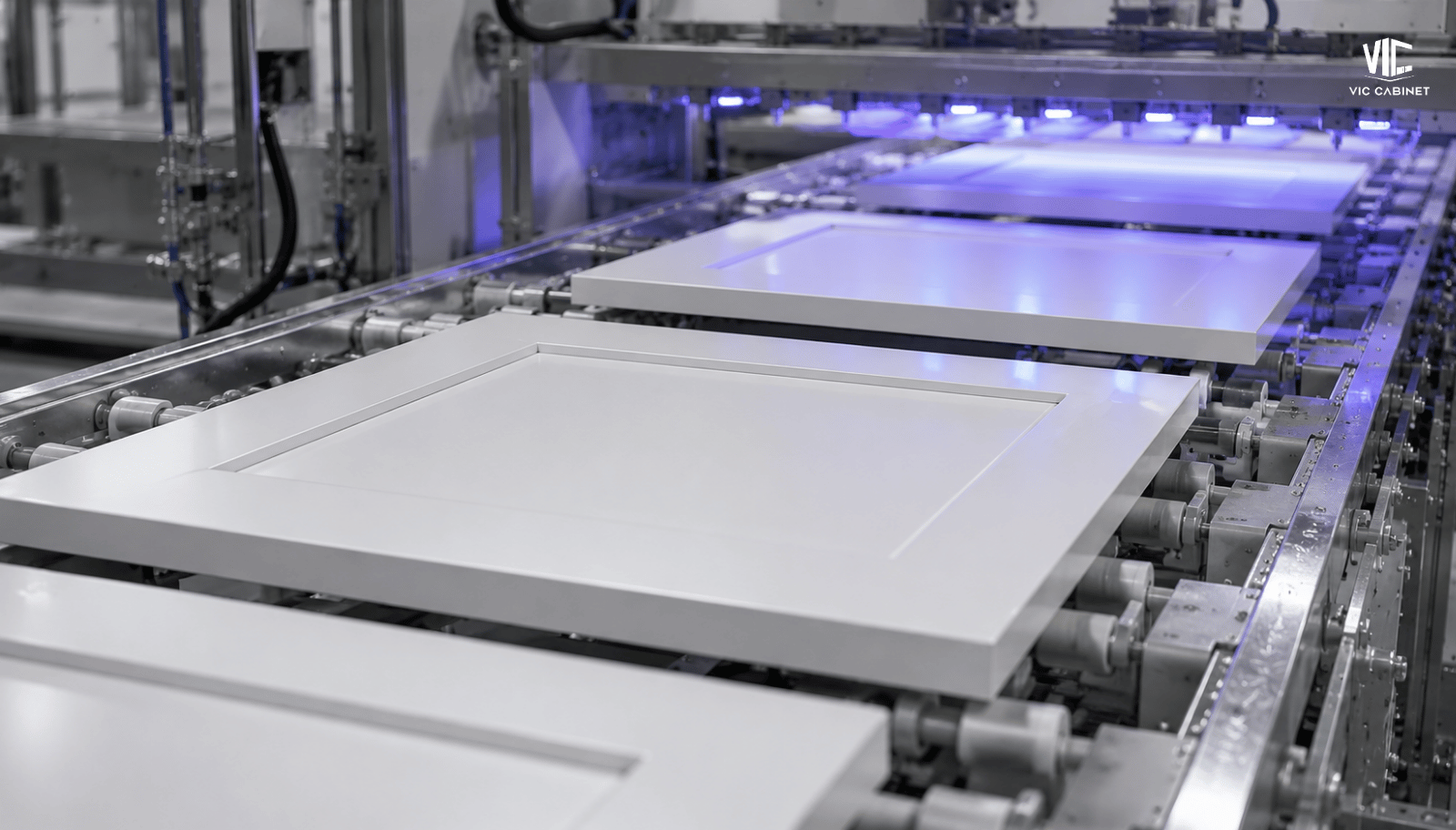
To survive the high-turnover environment of multi-family rental units or high-end residential upgrades, cabinet joinery cannot rely on simple glue and finish nails. The drawer boxes must feature true interlocking English dovetail joints with a 1/4-inch plywood drawer bottom fully captured on all four sides. Main cabinet carcasses must be assembled using wood dowels, pocket screws, or heavy-duty metal corner brackets depending on whether the order calls for frameless or face-frame construction.
Surface finish application is where amateur factories fail. A professional oem cabinet manufacturer utilizes fully enclosed, dust-free automated finishing lines. The coating process for a standard white shaker door involves a rigid multi-step sequence:
- Automated wide-belt sanding followed by manual detail grain prepped to 220-grit smoothness.
- Application of two separate coats of catalyzed polyurethane primer to seal the wood pores.
- Precision orbital sanding to eliminate surface imperfections.
- Two coats of pigmented acid-catalyzed conversion varnish or automated UV-cured topcoats.
The cured finish must pass the KCMA 24-hour chemical resistance test, showing zero blistering, softening, or discoloration when exposed to common household agents like vinegar, lemon juice, boiling water, and olive oil.
3.4, Advanced CNC Production and QC Protocols for Batch Consistency
For large-scale commercial developments, batch consistency is the ultimate metric of success. If a replacement door ordered for a multi-family unit six months after the initial install arrives with a 1mm sizing error or a visible color variance, the general contractor faces costly project delays.
Achieving identical tolerances across multiple container runs requires extensive automation. The factory floor must run heavy-duty computer numerical control (CNC) nesting centers and automated linear edge-banders that operate within a tolerance of +/- 0.5mm.
Quality control cannot be an afterthought at the packaging station. A reliable manufacturer runs an active in-line QC protocol:
- Moisture Testing: Pinless moisture meters check 100% of incoming lumber lots.
- Color Matching: Digital spectrophotometers read delta-E color values on the coating line, ensuring that variance between batch 1 and batch 50 remains completely imperceptible to the human eye.
- Dry Layout Inspection: QC teams randomly pull 5% of parts from the assembly line daily to complete a full dry-fit mock assembly, verifying alignment of face frames, door gaps, and hardware tracking before boxing.
These manufacturing standards are only one part of a successful sourcing strategy. For a broader framework covering supplier evaluation, production capabilities, project requirements, and procurement best practices, explore our Cabinet Manufacturer Guide for Projects and Sourcing.
3.5, Container Cargo Optimization for RTA Cabinets and FA Vanity
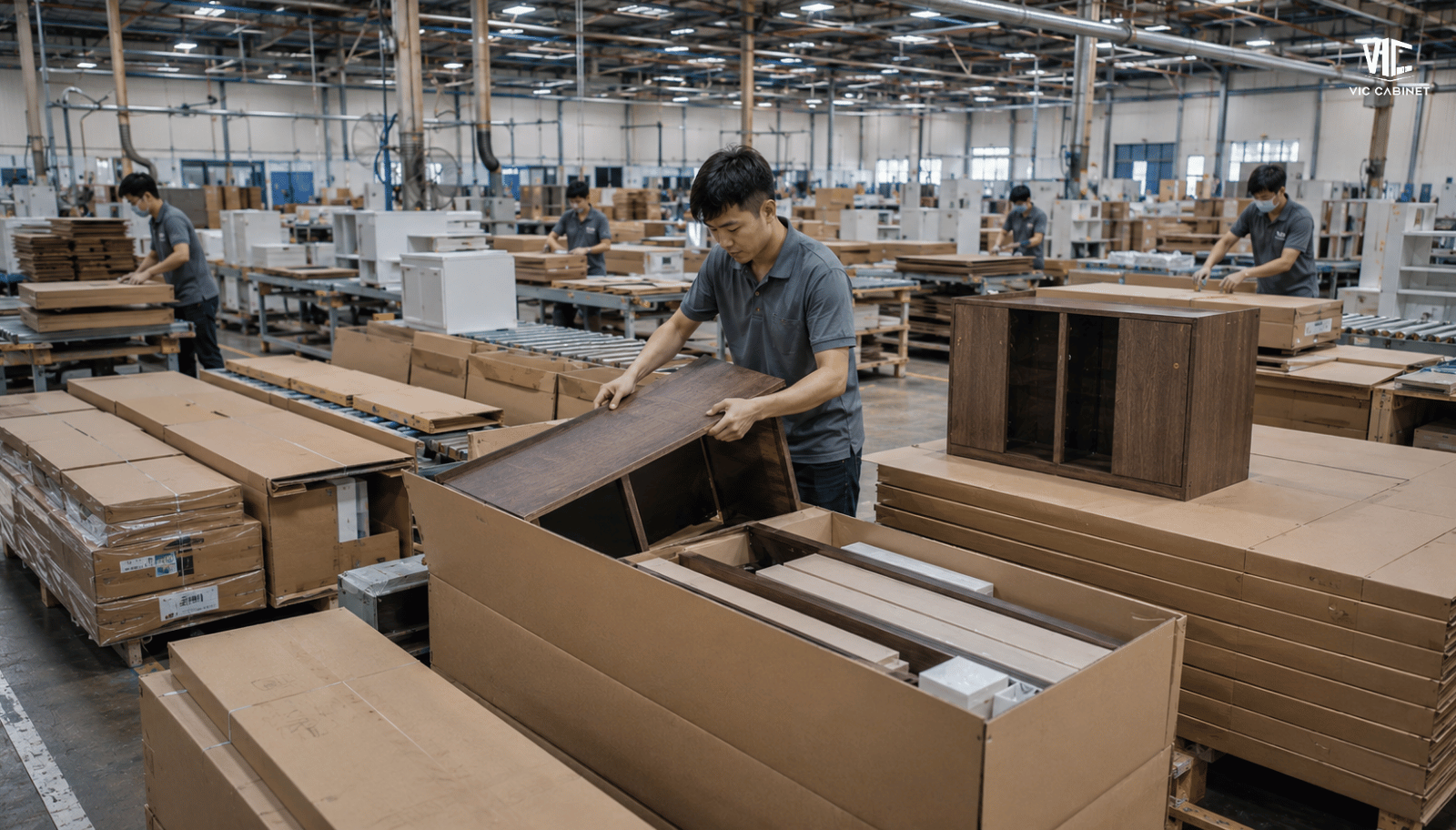
Landed cost efficiency is heavily dictated by maritime logistics engineering. An experienced export manufacturer designs packaging based on strict container volume math.
For Ready-to-Assemble (RTA) kitchen cabinets, products are flat-packed using heavy-duty, double-wall corrugated cardboard boxes rated for export shipping. Every individual panel must be separated by high-density polyethylene (HDPE) foam sheets, with reinforced molded corner guards protecting the edges from forklift impacts during container stuffing and unloading.
For structural items like a Fully Assembled (FA) vanity, the engineering team must calculate precise structural pallet configurations. Vanities are secured upright on custom timber pallets, wrapped in heavy shrink-film, and fitted with internal vertical support struts. This precise calculation prevents top-crushing during ocean transit inside a 40ft HC container, maximizing cubic space utilization and eliminating the financial nightmare of transit-damaged face frames.
4. Partner with VIC Cabinet: Your Trusted B2B Manufacturing Partner
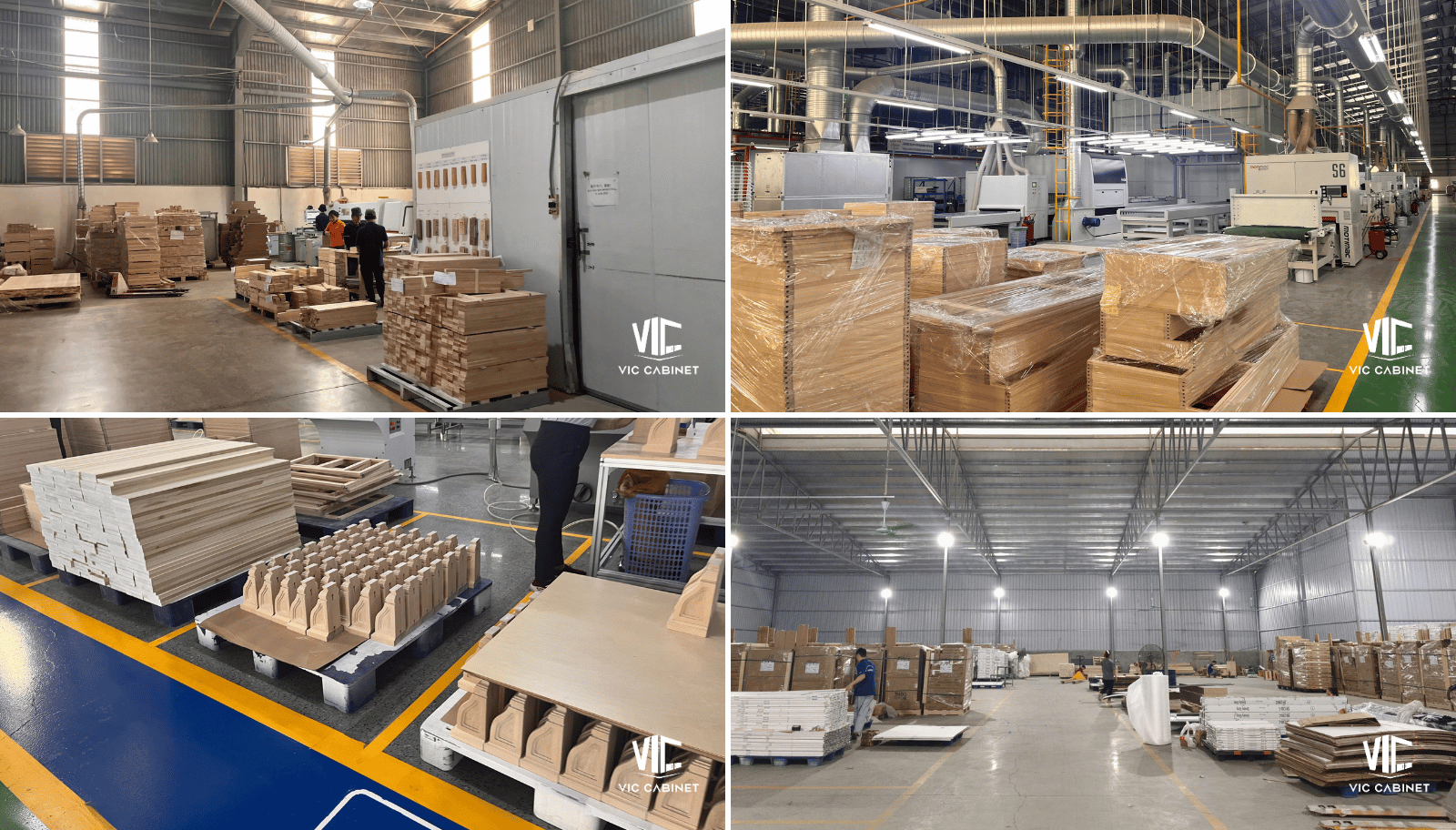
VIC Cabinet operates as a highly specialized, industrial-scale cabinetry manufacturer in Vietnam, geared exclusively toward the high-volume needs of US distributors, wholesale supply chains, and large commercial developers. Headquartered with our corporate management office in Hanoi and supported by our strategic logistics and regional operations team in Ho Chi Minh City, we maintain the infrastructure required to execute seamless, container-level export operations.
Our manufacturing capabilities are optimized for a versatile, export-ready product mix designed specifically for the North American market:
- Kitchen & Vanity Cabinets: Available in both traditional American Face-Frame (3/4-inch solid wood frames) and modern European Frameless (Full-overlay construction using premium plywood or particleboard cores).
- Closet Systems & Built-ins: High-precision, customizable walk-in and reach-in closet systems utilizing durable MFC or laminate finishes with 32mm adjustable line boring.
- Flexible Assembly Configurations: Scalable production capacity for flat-packed RTA cabinets to maximize container volume, or pre-polished Fully Assembled vanities ready for immediate jobsite installation.
VIC Cabinet operates with a transparent, partner-focused business model designed to simplify overseas sourcing. Instead of relying on unclear supplier terms, we provide contract-based Minimum Order Quantities (MOQs) tailored to different project scales. In addition, we offer guaranteed production lead times and comprehensive quality warranties on all shipped components. As a result, procurement teams can plan purchases with greater confidence and predictability. Furthermore, US buyers gain access to direct factory-door pricing and structural engineering support for proprietary shop drawings. Meanwhile, our logistics team manages container shipments from the factory floor to major US ports. Consequently, distributors can reduce sourcing complexity while maintaining a reliable supply chain.
5. Conclusion
Shifting procurement lines to a dedicated cabinet oem manufacturer in Vietnam is a proven, reliable method for North American brands to eliminate prohibitive trade tariffs and reduce raw material overhead. By strictly enforcing structural indicators, including certified CARB Phase 2 wood substrates, precision hardware integration, and multi-stage automated finish applications, wholesale distributors can scale their private label cabinets with absolute commercial security.
VIC Cabinet stands ready as your long-term industrial partner, combining advanced automation with deep export expertise to protect your bottom line and guarantee batch consistency across every single shipping container.
Are you ready to optimize your corporate supply chain, eliminate trading middleman margins, and secure a stable production foundation for your private label cabinetry line? Contact our export team to request MOQ & pricing details today.
FAQ about Cabinet OEM
1, What is the typical lead time for an oem kitchen cabinets order from Vietnam?
For recurring container-volume orders, VIC Cabinet typically requires 35 to 45 days from shop drawing approval to container loading. However, first-run projects may take longer. For example, custom tooling or proprietary stain development can add 10 to 15 days. As a result, early planning helps keep production on schedule.
2, Are private label cabinets from Vietnam compliant with KCMA standards?
Yes, professional export manufacturers like VIC Cabinet engineer private label cabinets to meet Kitchen Cabinet Manufacturers Association (KCMA) performance standards. To achieve this, they use certified 5/8-inch or 1/2-inch CARB Phase 2 plywood carcasses. In addition, the cabinets feature true interlocking dovetail joinery for greater structural strength. Furthermore, heavy-duty conversion varnishes help protect surfaces from daily wear. As a result, the products can withstand demanding heat, humidity, and chemical exposure tests. Therefore, distributors can offer cabinets that meet strict performance expectations in the US market.
3, How does an oem cabinet manufacturer ensure color consistency across production batches?
Industrial OEM operations maintain strict color control by utilizing computerized fluid mixing stations for all paints and stains, alongside enclosed, automated linear spray lines. Production QC teams at VIC Cabinet utilize digital spectrophotometers to analyze finished components against an approved master control swatch, ensuring the delta-E variance across separate container runs remains well within strict commercial trade tolerances.
4, What are the common packaging methods for exporting RTA cabinets to the US?
Ready-to-Assemble (RTA) cabinets are flat-packed inside heavy-duty, double-wall corrugated cardboard cartons stamped with strict drop-test certifications. Internally, all finished faces are isolated with protective foam sheets, and all perimeter edges are encased in high-density foam blocks to absorb kinetic shocks and prevent shifting during ocean transport.
