


The best kitchen cabinet paint colors ideas are not just about trends. Light neutrals like white and beige expand space, while navy and green add depth. However, the real difference comes from surface coating, lighting conditions, and cabinet material, which directly affect how colors look and last over time.
1. Kitchen Cabinet Paint Colors Ideas That Feel Right, Not Just Look Good
Most people choose colors from Pinterest. Then they feel something is “off” after installation.
From what we have seen in real kitchens, color success depends on three things:
- Light reflection
- Daily usage intensity
- Surface finish behavior
White cabinets may look clean online, but in a low-light kitchen, they can feel dull. Dark colors may look premium, but without proper lighting, they make the space feel heavy.
What actually works in real homes
- Soft white instead of pure white for long-term comfort
- Warm beige instead of cool gray to avoid color shifting
- Muted tones instead of high contrast for daily use kitchens
Expert tip: If you cook daily, avoid ultra-matte finishes. They absorb grease faster than you expect.
2. Painted Kitchen Cabinets Color Ideas by Lifestyle, Not Trend
Most blogs group colors by trend.
But in real kitchens, color decisions are driven by how you actually live.
From what we have seen across different households, the same color can feel perfect in one home and completely wrong in another.
The key is not the color itself.
It is how that color interacts with your daily habits.
2.1 Low-maintenance lifestyle: Colors that hide reality, not just look clean
If you cook often, your cabinets will face:
- Grease particles in the air
- Fingerprints from daily use
- Water splashes near sink areas
In this case, the goal is not “clean-looking color”.
It is forgiving color.
Best choices:
- Warm beige
- Light taupe
- Soft greige

These tones:
- Diffuse light softly
- Hide smudges better than pure white
- Age more evenly over time
What most people get wrong:
They choose pure white thinking it looks clean.
In reality, white shows dirt faster than any other color.
2.2 Design-focused homeowners: High contrast, high responsibility
If your priority is aesthetics, bold colors can create strong visual identity.
Popular choices:
- Navy
- Matte black
- Deep forest green

These colors:
- Add depth and contrast
- Create a premium, custom-built feeling
However, they come with trade-offs:
- Scratches are more visible
- Dust appears faster under light
- Require better lighting design
Real insight:
Dark cabinets only look “luxury” when paired with:
- Proper under-cabinet lighting
- Balanced wall and countertop colors
Without that, they can feel heavy and visually compress the space.
For a deeper understanding of how dark tones behave in real kitchens, see How Black Kitchen Cabinets Work in Modern Home Kitchens.
For more inspiration on bold but livable colors, check Blue Kitchen Cabinets | Styles and Design Ideas for Modern Homes.
2.3 Family kitchens: Colors that reduce visual stress over time
In homes with frequent cooking and multiple users, visual comfort matters more than style.
You are not just looking at the cabinets.
You are living with them every day.
Recommended tones:
- Soft greige
- Muted warm gray
- Wood-tone painted finishes

These colors:
- Reduce contrast fatigue
- Blend naturally with different materials
- Stay visually stable even as the kitchen ages
Why this works:
High-contrast kitchens may look impressive at first,
but they can become tiring after long-term use.
If you are considering neutral tones, explore Grey Kitchen Cabinets for Modern and Shaker Styles for more practical combinations.
2.4 Small kitchens: Light reflection is more important than color preference
In compact kitchens, color is a tool to manipulate space perception.
Best options:
- Off-white
- Cream
- Soft reflective neutrals
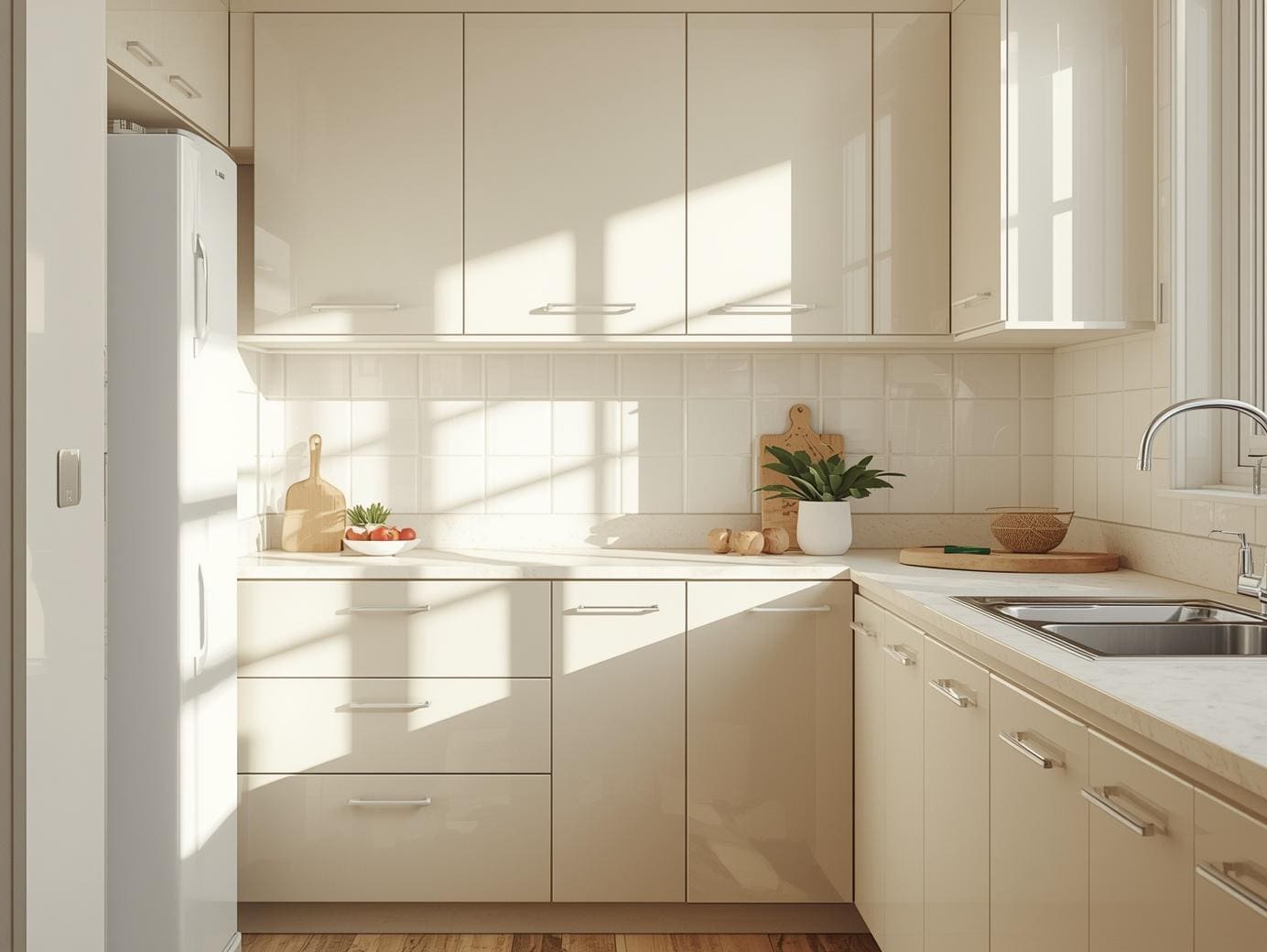
These colors:
- Reflect more light
- Blur edges between surfaces
- Make the kitchen feel larger than it is
Important nuance:
Not all light colors behave the same.
- Cool white → can feel sterile
- Warm white → feels more natural and comfortable
2.5 Open-concept kitchens: Color must connect, not stand alone
If your kitchen is part of a larger living space, cabinet color cannot be chosen independently.
It must relate to:
- Flooring tone
- Wall color
- Adjacent furniture

Safe combinations:
- Beige cabinets + wood flooring
- White cabinets + warm neutral walls
- Navy cabinets + light countertop
Expert tip:
If your cabinet color stands out too much from the rest of the space,
it will feel disconnected, not premium.
Key takeaway from real projects
There is no “best” color.
There is only:
- The right color for your lifestyle
- The wrong color for your usage pattern
That is why painted kitchen cabinets color ideas should always start from how you use your kitchen, not how it looks on a screen.
3. Painting Kitchen Cabinets Color Ideas: Why Material and Coating Matter More Than Color
This is the part most blogs ignore.
You can pick the perfect color, but if the material or coating is wrong, the result will fail within months.
3.1 Surface coating decides how color behaves
| Coating System | Scratch Resistance | Moisture Protection | Color Stability |
| AC PU oil-based | High | High | Very stable |
| Water-based paint | Medium | Medium | May fade |
| Laminate finish | Very high | Very high | Fixed color |
In real installations, we often see white cabinets turning yellow after 1–2 years.
The cause is not the color. It is the coating lacking UV resistance.
At Vic Cabinet, we use multi-layer AC PU coatings. This creates a dense film that:
- Prevents moisture penetration
- Maintains color under heat and grease exposure
- Reduces micro-cracking at joints
3.2 Why the same color looks different in different kitchens
Color is not fixed. It changes based on:
- Light temperature (3000K vs 4000K)
- Cabinet surface texture (matte vs semi-gloss)
- Substrate absorption (plywood vs MDF)
For example:
- Cool gray under warm light becomes slightly green
- Pure white under yellow lighting looks creamy
Real observation:
We tested the same navy paint on two kitchens.
One looked deep and rich. The other looked flat.
The difference was lighting, not paint.
3.3 The hidden role of cabinet material (most people ignore this)
Paint sits on top, but the material underneath controls stability.
| Material | Moisture Expansion | Paint Adhesion | Long-term Stability |
| Solid wood | High | Medium | Risk of cracking |
| MDF (standard) | Medium | High | Moderate |
| Plywood (engineered) | Low | High | Very stable |
Counter-intuitive insight
Expensive solid wood is not always the best choice for painted cabinets.
Why?
- Wood expands and contracts with humidity
- This creates hairline cracks in painted surfaces
- Especially visible on white and dark colors
Engineered plywood often performs better because:
- It has stable density
- Lower expansion rate
- More consistent paint finish
3.4 Finish type affects daily experience more than color
- Matte finish: soft look, but harder to clean
- Semi-gloss: balanced, most practical for kitchens
- High gloss: reflective, but shows fingerprints
Expert recommendation:
For most homes, semi-gloss is the safest choice.
It balances aesthetics and maintenance.
3.5 Where most painted cabinets fail (real mistakes)
From installation experience, failures usually happen at:
- Edges and joints
- Sink area (high humidity)
- Around stove (heat + grease)
Checklist to avoid failure
- Use sealed edges with multi-layer coating
- Avoid water-based paint near sink zones
- Ensure proper curing time before installation
4. Kitchen Paint Ideas with White Cabinets That Do Not Feel Boring
White cabinets are popular, but often executed poorly.
Better combinations
- White cabinets + warm beige walls
- White cabinets + soft green accents
- White cabinets + natural wood elements
These combinations create depth without losing brightness.
What to avoid
- White cabinets + white walls → flat space
- White cabinets + cool gray → cold feeling
Expert tip:
Instead of changing cabinet color, change wall tone and lighting first.
It is more cost-effective and often solves the problem.
If you want to explore how to make white cabinets feel warmer and more balanced, read A Practical Guide to White Kitchen Cabinets and Finishes.
5. How to Choose the Right Kitchen Cabinet Paint Colors Ideas (Decision Framework)
Choosing kitchen cabinet paint colors ideas should not rely on feeling alone.
A good decision comes from matching color with real conditions.
Step 1: Read your lighting first
- Natural light < 4 hours/day → avoid cool gray
- Warm LED (3000K) → makes white look yellow
- Mixed lighting → choose neutral-warm tones
Rule: Always test color under both daylight and night lighting before final decision.
Step 2: Define your usage level
- Heavy cooking → choose semi-gloss, mid-tone colors
- Light cooking → more flexibility with matte and dark tones
Why: Grease and fingerprints behave differently on each finish.
Step 3: Balance space proportions
- Small kitchen → light, reflective colors
- Low ceiling → avoid dark upper cabinets
- Large space → can use contrast safely
Step 4: Choose finish before color
This is where most people make mistakes.
- Matte → soft look, harder to clean
- Semi-gloss → balanced, most practical
- Gloss → reflective but high maintenance
Expert rule: If unsure, choose semi-gloss first, then pick color.
Quick decision summary
- Small + low light → warm white or beige
- High usage → greige or taupe
- Design focus → navy or deep green (with good lighting)
6. Maintenance Rules That Protect Your Cabinet Color
Even the best painting kitchen cabinets color ideas will fail without proper maintenance.
Daily care that actually matters
- Use pH-neutral cleaner only
- Avoid rough or dry cloth on dark finishes
- Wipe water within minutes near sink zones
Where problems really start (not where you think)
Most people think paint fails on flat surfaces.
In reality, failure starts at:
- Edges
- Joints
- Underside of cabinets near sink
These areas absorb moisture first.
Technical insight from real installations
Paint does not peel because of “bad paint”.
It peels because moisture enters through micro gaps.
That is why:
- Edge sealing quality matters more than paint brand
- Multi-layer coating performs better than single thick layer
Simple rule to extend cabinet life
If you want your cabinet color to last 7–10 years:
- Control moisture
- Avoid heat concentration
- Clean regularly but gently
Conclusion
The best kitchen cabinet paint colors ideas are not about picking the most beautiful shade.
They are about choosing a color that:
- Works with your light
- Matches your lifestyle
- Survives real kitchen conditions
From what we have seen across real installations,
the kitchens that age well are not the boldest ones.
They are the ones built with the right balance between color, material, and finish.
