


1. U.S. Cabinet Market Trends 2024: Size and Growth Outlook
The U.S. residential cabinet market was valued at $37.5 billion in 2023 and is projected to reach $51.5 billion by 2029, according to ResearchAndMarkets. That figure represents a CAGR of 5.42% over the forecast period. The Freedonia Group separately recorded demand of 83 million kitchen cabinet units in 2024, with base cabinets holding the largest share by volume.
IBISWorld data narrows the lens to domestic production: the U.S. cabinet and vanity manufacturing sector grew 2.6% in 2024, reaching $21.9 billion in output value. The gap between retail market size and manufacturing output reflects the weight of imports. A significant portion of cabinets sold in the U.S. are produced overseas, particularly in Vietnam, China, and Malaysia, and distributed through domestic importers and wholesale networks.

Technavio’s global cabinet forecast projects a CAGR of 6.4% between 2024 and 2029, adding $28.21 billion in incremental market value globally. North American demand is a key contributor, supported by persistent renovation spending and a gradual recovery in multifamily construction pipelines heading into 2025.
2. What Is Driving U.S. Cabinet Market Trends in 2024
 2.1 Renovation Activity Outpaces New Construction
In 2024, repair and remodeling (R&R) projects were the dominant demand driver for cabinets, not new-home construction. Cabinet replacement cycles typically run 15 to 20 years, which creates a predictable cadence of demand independent of housing transaction volumes. Homeowners with locked-in low-rate mortgages chose to upgrade existing kitchens and bathrooms rather than move, keeping R&R spending stable despite a slower transaction market.
The National Kitchen and Bath Association (NKBA) tracked steady project volumes through most of 2024. Residential remodeling held up even as new housing starts remained below pre-2022 levels. This pattern benefited distributors with strong dealer and contractor networks more than those reliant on new-home builder channels.
2.2 RTA Cabinets: The Fastest-Growing Segment
Ready-to-assemble (RTA) cabinets carried a projected CAGR of 6.1% through 2029, the highest of any product segment in the U.S. market. Three factors drive this performance: lower retail price points compared to assembled formats, shorter lead times from stock inventory, and compatibility with DIY installation trends that accelerated during post-pandemic home improvement cycles.
RTA formats also benefit from the growth of digital sales channels. Online configurators and guided layout tools have reduced the complexity of ordering RTA systems, making them accessible to homeowners who previously depended on a kitchen designer. For overseas manufacturers, RTA-ready production capacity is increasingly a baseline requirement for U.S. distributor qualification.
2.3 Home Office Cabinets: An Emerging Demand Category
The home office cabinet segment recorded the highest segmental CAGR in the U.S. market at 6.4%, driven by the continued normalization of hybrid and remote work arrangements. Buyer priorities in this segment center on cable management integration, built-in charging stations, and modular configurations that adapt to different room sizes. This segment is less price-sensitive than kitchen cabinets, with buyers emphasizing functionality and finish quality over unit cost.
3. Consumer Preferences Reshaping the Cabinet Market in 2024
3.1 Semi-Custom Leads, Full Custom Remains a Niche
Semi-custom cabinets held the largest market share in 2024, accounting for approximately 37-38% of kitchen cabinet demand by value (Mordor Intelligence). This segment offers buyers a degree of personalization without the cost and lead time of full custom manufacturing. Stock cabinets remained dominant in multifamily and entry-level residential projects, where speed and price consistency matter more than design flexibility.
Full custom remained a premium niche, concentrated in high-end single-family new construction and luxury renovation projects. For overseas manufacturers targeting the U.S. market, semi-custom production capability (configurable sizes, finish options, door style flexibility) positions a supplier to serve the broadest range of distributor accounts without the overhead of full custom workflows.
3.2 Features Buyers Expect in 2024
| Feature | Market Status in 2024 | Applicable Segment |
|---|---|---|
| Soft-close hinges and drawer slides | Standard, no longer a premium add-on | All price tiers |
| Integrated LED lighting | Growing; expected in mid-range and above | Mid to high |
| Built-in USB / charging stations | Emerging; standard in home office segment | Mid to high |
| Modular pull-out organizers | Widely offered; strong consumer demand | All tiers |
| FSC-certified wood substrate | Required for major retail and dealer channels | All tiers |
| Low-VOC / CARB-compliant finish | Mandatory for California distribution | All tiers |
| Frameless / Eurostyle construction | Growing share in urban and space-constrained markets | Mid to high |
4. Sustainability and Compliance: From Differentiator to Requirement
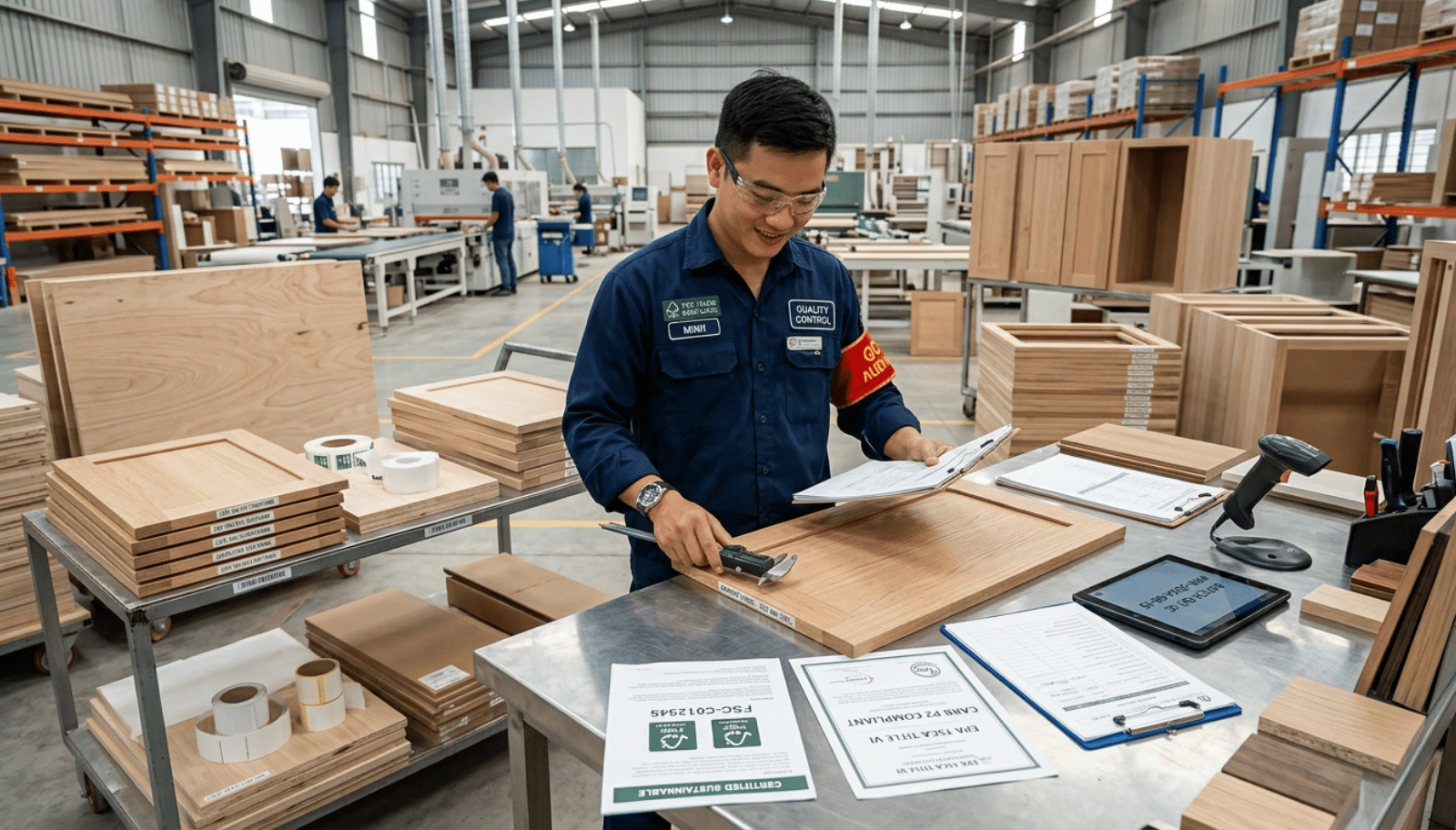
Sustainability shifted from a marketing differentiator to a sourcing qualification requirement between 2022 and 2024. U.S. importers and major distributors now require certification documentation from overseas suppliers before approving a new product line for distribution. Two certifications carry the most weight in purchasing decisions: FSC Chain of Custody (for responsible wood sourcing) and CARB Phase 2 compliance (for formaldehyde emissions in composite panels).
California Air Resources Board (CARB) Phase 2 limits apply to hardwood plywood, particleboard, and medium-density fiberboard (MDF). Non-compliant products cannot legally be sold in California, which represents the largest single state market for cabinets in the U.S. Suppliers without documented CARB compliance are excluded from a significant portion of distribution channels, regardless of price competitiveness.
- FSC Chain of Custody certificate for wood panels and solid wood components
- CARB Phase 2 / TSCA Title VI compliance for all composite panels (plywood, MDF, particleboard)
- Low-VOC finish documentation (required for California and green-certified building projects)
- IKEA IWAY or equivalent supplier code of conduct (required for large retail accounts)
- ISO 9001 quality management certification
5. Supply Chain Pressures Defining Cabinet Market Trends in 2024
Three cost pressures shaped supplier and importer decisions throughout 2024. First, hardwood and veneer prices remained elevated relative to pre-2021 levels, pushing manufacturers toward engineered substrates and domestically sourced alternatives where tolerances allowed. Second, U.S. Section 301 tariffs of 25% on finished cabinets from China continued redirecting sourcing toward Vietnam, Malaysia, and other Southeast Asian origins. Third, shipping lead time variability stabilized compared to 2022-2023 peaks, but importers maintained higher inventory buffers than before the supply disruptions.
Industry consolidation also intensified. MasterBrand acquired Supreme Cabinetry Brands and Dura Supreme in mid-2024, while American Woodmark opened new plants in North Carolina and Monterrey, Mexico in April 2024, adding 15% production capacity. These moves raised the quality consistency bar that distributors expect from any supplier, domestic or overseas.
| Pressure Factor | Impact on Importers | Recommended Response |
|---|---|---|
| Elevated hardwood costs | Higher FOB price from suppliers | Negotiate multi-month fixed-price agreements |
| Section 301 tariffs on China origin | Sourcing shift to Vietnam / Malaysia | Verify Certificate of Origin documentation |
| Inventory buffer requirements | Higher working capital commitment | Work with suppliers offering bonded warehouse or consignment options |
| Consolidation among U.S. brands | Higher quality bar from distributors | Require QC inspection reports and batch test certificates per order |
6. What U.S. Importers Should Prioritize When Sourcing Cabinets in 2024

The data from 2024 points to a market where price remains important but is no longer the primary qualification criterion. Importers who performed well shared three characteristics: they worked with manufacturers offering documented quality control processes, they prioritized compliance certifications before placing first orders rather than treating documentation as an afterthought, and they maintained multi-format product ranges covering both RTA and assembled options to serve different end channels.
Lead time consistency ranked above lead time speed as a distributor priority. Dealer networks managing project timelines for contractors value predictability. A supplier that reliably delivers in 45 days is operationally preferable to one that promises 30 days but varies by 10 to 15 days per order. This preference is reflected in how U.S. distributors now structure supplier agreements, with penalties or credit terms tied to on-time delivery rates rather than just unit pricing.
- Request batch QC inspection reports as part of standard purchase order terms
- Confirm CARB Phase 2 and FSC status before placing first order
- Evaluate supplier capacity for both RTA flat-pack and assembled cabinet formats
- Check door style range: shaker, frameless, and inset cover the highest U.S. demand categories
- Verify Certificate of Origin to ensure tariff compliance at U.S. customs
- Clarify lead time commitments in writing, including credit terms for delays
VIC Cabinet’s production facility in Hanoi manufactures shaker, slim shaker, frameless, and inset cabinets across RTA and assembled formats. All products carry CARB Phase 2 compliance documentation. We work with U.S. importers and distributors who need a manufacturing partner with verifiable quality processes, not just a competitive FOB price.
𝐕𝐈𝐂 𝐂𝐚𝐛𝐢𝐧𝐞𝐭 𝐅𝐚𝐜𝐭𝐨𝐫𝐲
Head Office: Tran Thu Do Street, Hoang Liet, Hoang Mai District, Hanoi, Vietnam
HCM Office: N8 Street, Phu Thuan, District 7, Ho Chi Minh City, Vietnam
Phone: +(84) 986 119 249
Website: viccabinet.com
Email: info@viccorp.com.vn
