


In 2024, wood trade conflict impacts are driving a 25% surge in timber costs. Additionally, they are disrupting plywood logistics via the Red Sea. Consequently, manufacturers must now pivot from Eastern European sources to sustainable hubs like Vietnam. This strategic shift ensures material availability and price stability. Ultimately, it effectively mitigates global supply risks while maintaining high-end architectural standards.
1. The Geopolitical Shift in Timber Sourcing
The landscape of the global wood trade has undergone a fundamental transformation since late 2023. Specifically, sanctions on Russian and Belarusian timber have removed nearly 40 million cubic meters of wood from the Western market. For the cabinetry industry, this means the era of cheap birch plywood is effectively over. Therefore, factories are forced into a rapid transition toward alternative hardwoods.
Our factory floor observations at Vic Cabinet confirm that shipping delays for European Oak have doubled. Currently, these delays average 65 to 80 days. This volatility is not just about price; rather, it concerns the physical availability of Grade A materials. Because we see a massive influx of lower-quality substitutes, rigorous material inspection is now more critical than ever for high-end manufacturing.
2. Logistics Crises and the Red Sea Bottleneck
Beyond the availability of wood, the transportation process has become a major disadvantage in 2024. For instance, the conflict in the Red Sea has forced cargo ships to bypass the Suez Canal. Instead, they are rerouting around the Cape of Good Hope. This change adds approximately 4,000 nautical miles to the journey. As a result, it directly impacts the lead time of international cabinet exports.
| Logistics Factor | Pre-Conflict Status | 2024 Current Status | Impact on Cabinetry |
| Transit Time (Asia to EU) | 30-35 Days | 45-60 Days | Delayed Project Installation |
| Container Freight Cost | $1,500 to $2,000 | $4,500 to $6,500 | 12% Hike in Retail Pricing |
| Fuel Surcharge | Minimal | High (Varies Weekly) | Price Quote Instability |
| Route Reliability | High | Unpredictable | Inventory Overstock Risks |
3. Strategic Responses to Wood Trade Conflict Impacts 2024
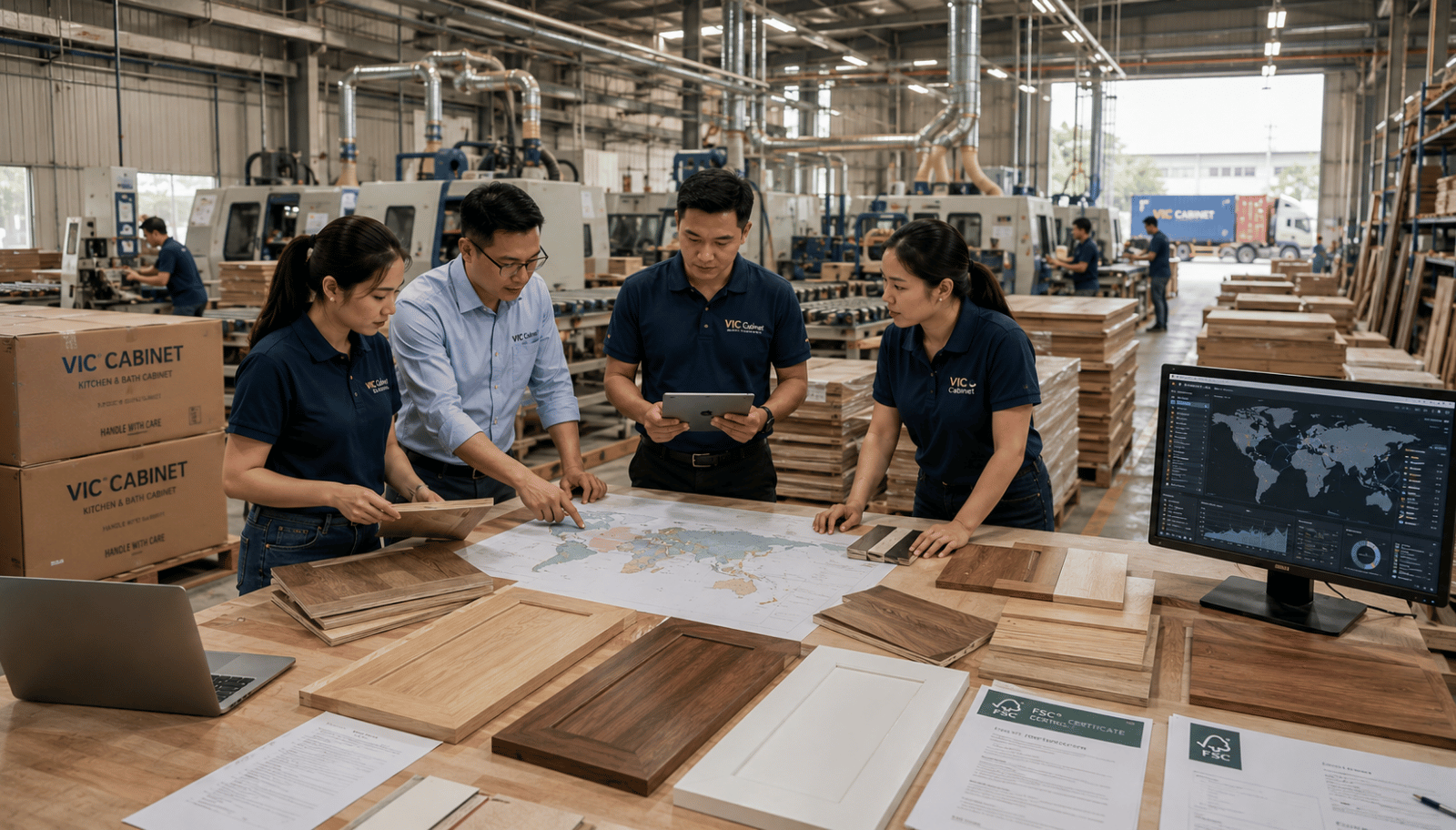
This section represents the core challenge for modern cabinetry. Specifically, it addresses how to maintain luxury standards while the global supply chain is fractured. At Vic Cabinet, we have identified four critical pillars to navigate these wood trade conflict impacts 2024 effectively.
3.1 Diversifying Beyond Traditional Hardwood Borders
The reliance on a single geographic region is now a liability. Consequently, we have expanded our supply network to include verified sustainable plantations in South America and Southeast Asia. By diversifying, we ensure that a conflict in one region does not halt our production line. For example, we prioritize species like Acacia and Rubberwood for core structures. These offer comparable density but much higher supply resilience.
3.2 Implementing EUDR Compliance and Digital Traceability
The European Union Deforestation Regulation (EUDR) is a non-negotiable hurdle in 2024. Therefore, we have implemented a “Grain-to-Gallery” tracking system. Each batch of timber entering our facility must have GPS coordinates of its origin. This level of transparency is no longer an option. Instead, it is a prerequisite for any manufacturer aiming for the US and EU markets. Furthermore, failure to comply leads to heavy fines.
3.3 Enhancing Material Engineering to Reduce Waste
When raw material costs rise by 20%, technical efficiency becomes the only way to protect the customer’s budget. To achieve this, Vic Cabinet has invested in precision CNC machinery. This technology reduces wood off-cut waste by 14% compared to standard industry practices. Additionally, we utilize high-density fiberboards (HDF) for specific components. These provide a more warp-resistant product at a stable price point.
3.4 Securing Long-term Fixed-Price Timber Contracts
To protect our clients from weekly price fluctuations, we have shifted from spot-buying to 12-month fixed-price contracts. Although this strategy requires significant capital upfront, it allows us to guarantee pricing for large-scale developments. Most importantly, it eliminates the “Estimate vs. Actual” price gap. This gap often plagues homeowners during long-term renovation projects.
4. Technical Quality Standards: The Vic Expert Protocol
A counter-intuitive reality of 2024 is that natural wood is not always the safest choice. Because of the scarcity caused by trade conflicts, many suppliers are stretching their inventory. Often, they mix species or use younger, less stable trees.
Through our extensive experience, we have found that moisture-resistant HDF with a premium veneer often outperforms budget solid wood. The reason lies in the internal tension of the wood grain. Specifically, younger solid wood is prone to significant expansion when exposed to household humidity.
-
Internal Moisture Verification: Always check the Moisture Content (MC) of your cabinet doors. In 2024, rushed production often leads to MC levels above 12%. Consequently, your cabinets may crack or warp within the first year. We maintain a strict 6% to 8% MC standard for all export-grade products.
-
Surface Tension Analysis: We apply a specialized coating process. This balances the surface tension between the interior and exterior of the door panel. As a result, it prevents the “cupping” effect commonly seen in lower-priced alternatives.
5. Vietnam as the Strategic Hub for Cabinetry Resilience
Vietnam has emerged as a powerhouse in 2024 because of its unique “Neutral Gate” status. By maintaining strong trade ties with both the West and Asia, manufacturers like Vic Cabinet can source raw materials more easily. Furthermore, our proximity to deep-water ports allows us to mitigate the global logistics lag. This lag currently hampers land-locked or politically isolated manufacturers.
In conclusion, we recommend that developers prioritize manufacturers who own their supply chain. This transparency is the only way to ensure your 2024 kitchen renovation remains an asset. In an era of global trade uncertainty, knowing your source is the ultimate security.
𝐕𝐈𝐂 𝐂𝐚𝐛𝐢𝐧𝐞𝐭 𝐅𝐚𝐜𝐭𝐨𝐫𝐲
Head Office: Tran Thu Do Street, Hoang Liet, Hoang Mai District, Hanoi, Vietnam
HCM Office: N8 Street, Phu Thuan, District 7, Ho Chi Minh City, Vietnam
Phone: +(84) 986 119 249
Website: viccabinet.com
Email: info@viccorp.com.vn
