


Finding a dependable rta cabinet supplier is critical for scaling your kitchen cabinetry business. To secure the best margins and maintain consistent quality, distributors must evaluate a partner’s manufacturing capacity, batch consistency, and sea logistics. This guide provides a strategic framework to help you choose the right partner, maximize supply chain stability, and grow your profits.
1. Why Selecting the Right RTA Cabinet Supplier Impacts Your Bottom Line

In the US kitchen cabinet distribution and commercial contracting sectors, material procurement costs and supply chain reliability dictate financial performance. Partnering with an rta cabinet supplier is not just a standard purchasing transaction; it is the establishment of a critical link in your global supply chain.
An underperforming supplier can trigger severe project delays, inflate port demurrage fees, and result in costly contractual penalties from developers. Conversely, selecting the right supply partner optimizes cash flow, minimizes operational risks, and protects your brand reputation in the highly competitive US market.
2. Core Technical and Operational Criteria for Evaluating an RTA Cabinet Manufacturer
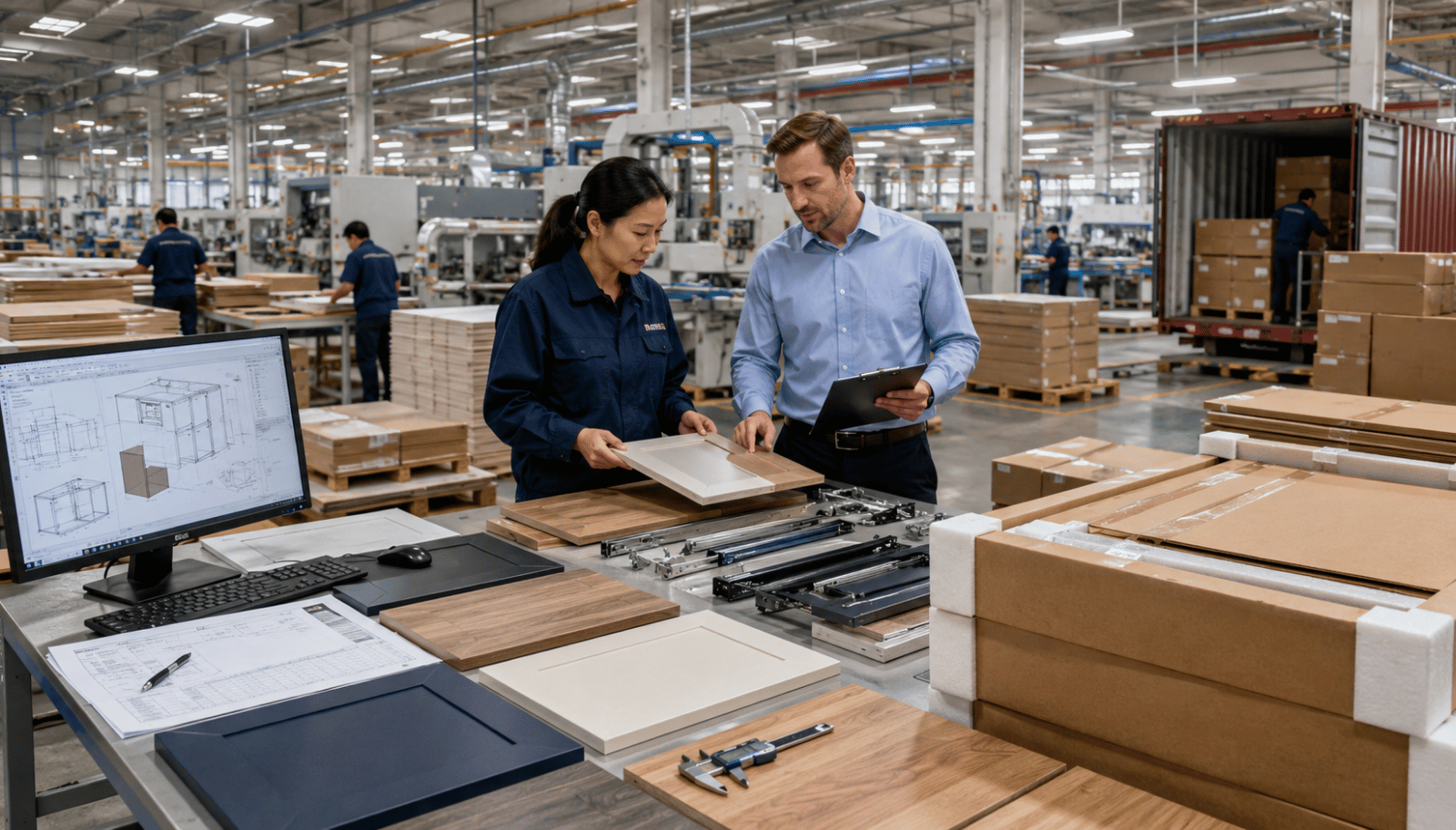
Distributor procurement demands strict evaluation metrics that go far beyond standard retail transactions. Therefore, when auditing an RTA cabinet manufacturer, international buyers should apply clear technical benchmarks to assess whether the supplier can reliably support high-volume, long-term container orders.
2.1. Production Capacity, MOQ, and Volume per Container Optimization
The monthly output of an rta cabinet manufacturer must be validated through verified export volumes, typically requiring a minimum of 20 to 50 containers per month for the US market. Minimum Order Quantity (MOQ) policies must remain flexible, allowing mixed product SKUs within a single container to optimize inventory breakdown. Professional procurement managers meticulously calculate cabinet packaging dimensions to maximize the volume of a 40ft HC container, effectively lowering the per-unit logistics cost.
2.2. Color Consistency Across Batches and In-House QC Systems
A frequent pain point for US cabinet distributors is color deviation between different production runs. A reputable rta cabinet manufacturer must maintain rigorous internal Quality Control (QC) systems, utilizing specialized spectrophotometers and a documented sample retention process. Maintaining absolute color stability for painted finishes (such as shifted whites or greys) and wood stains between a container produced today and one shipped six months later is a core measure of a factory’s technical capability.
2.3. Sea Freight Heavy-Duty Packaging and Complete Document Compliance (CO, CQ, PL, Invoice)
Flat-pack shipments undergoing long-distance ocean transit are highly vulnerable to humidity and mechanical impact. Therefore, an RTA cabinet manufacturer should use reinforced 5-ply or 7-ply cartons. These cartons should include high-density foam edge protectors. In addition, the supplier should prepare accurate shipment documents. These documents may include the Certificate of Origin, Certificate of Quality, packing list, and commercial invoice. As a result, importers can reduce clearance delays or customs review risks. Moreover, clear documentation helps customs brokers process shipments more efficiently.
2.4. Technical Drawing Interpretation, BOQ Take-offs, and Claims Handling for Defective Items
The engineering team at an rta cabinet manufacturer must possess the capability to interpret architectural CAD drawings and perform independent, precise Bill of Quantities (BOQ) take-offs. Seamlessly converting project layouts into standardized US modular cabinet configurations saves critical lead time during the estimation phase. Additionally, the factory must operate a transparent claims handling protocol, guaranteeing the replacement or credit of defective or missing items in the subsequent container without stalling job site progress.
For bathroom and hospitality projects, buyers should also evaluate moisture resistance, finish durability, and vanity construction standards. This guide on choosing a durable RTA bathroom vanity explains the key factors to review before placing a bulk order.
3. RTA Cabinet Factory Direct vs. Local Distributors
| Criteria | Sourcing Directly from an RTA Cabinet Factory | Buying from a Local U.S. Distributor |
|---|---|---|
| Cost | More competitive for bulk or container-level orders | Usually higher, but more convenient |
| MOQ | Commonly requires container-level volume | More flexible for small orders |
| Lead Time | Longer due to production and ocean freight | Faster if stock is available locally |
| Customization | Supports OEM, private label, custom colors, hardware, and packaging | Limited to stocked collections and standard options |
| Supply Control | Direct communication with the factory and production team | Depends on distributor inventory and policies |
| Best For | Importers, wholesalers, large builders, and commercial projects | Small contractors, urgent orders, and replacement needs |
Choosing between an RTA cabinet factory and a local U.S. distributor depends on order volume, project timeline, and how much control the buyer needs over product specifications. Factory-direct sourcing is often a better fit for importers, wholesalers, and large commercial buyers that purchase by container and need stable pricing, OEM flexibility, and long-term supply planning. Local distributors are more practical for smaller projects, urgent replacements, or buyers who prefer not to handle international shipping, customs clearance, and warehouse planning.
The main advantage of working directly with an RTA cabinet factory is stronger control over cost, cabinet design, packaging, and production schedules. Buyers can request specific door styles, finishes, hardware, carton markings, and private-label requirements. However, the factory price should always be reviewed together with the full landed cost, including ocean freight, import duties, customs clearance, inland delivery, warehousing, and inventory costs.
Local distributors offer speed and convenience when products are already in stock, but buyers are usually limited to available colors, sizes, and standard product lines. For businesses with stable demand, import experience, and warehouse capacity, factory-direct sourcing can create stronger long-term value. For small or urgent orders, buying from a local distributor may still be the more practical choice.
Before choosing a sourcing model, buyers should also understand the cost and quality differences between RTA vs assembled cabinets, especially for freight, storage, and large-volume distribution.
4. Strategic Operational Benefits of Wholesale RTA Cabinets for Large Projects

For multi-family residential developments or large-scale distribution networks, shifting to wholesale rta cabinets introduces immense operational efficiency.
4.1. Bulk Purchasing and Volume Predictability
By purchasing wholesale rta cabinets in volume, distributors can establish structured inventory release programs. Predictable container pipelines insulate businesses from sudden market shortages, ensuring that regional sub-contractors have access to uninterrupted supply.
4.2. Component Standardization for Multi-Unit Projects
Standardizing component specifications across massive multi-unit projects significantly accelerates on-site assembly and installation timelines. This modular predictability mitigates the risk of missing parts and substantially reduces high US job-site labor costs, directly protecting the general contractor’s project margins.
4.3. Phased Delivery and Repeatable SKU Programs
Large construction projects often require shipments divided into specific deployment phases to match on-site completion schedules. A professional wholesale rta cabinets program allows you to execute a phased delivery model, preventing site congestion and minimizing localized storage overhead. Furthermore, repeatable SKU programs help standardize cabinet schedules across multiple properties. As a result, your team can forecast inventory with greater accuracy. In addition, replacement parts remain easier to store and locate in your warehouse. Therefore, maintenance teams can respond faster when unexpected issues arise. Meanwhile, fewer custom parts help reduce extra fabrication lead times.
4.4. When Wholesale Purchasing May Not Be the Right Choice
While direct container sourcing offers superior margins, it may not suit every business model. If your business deals primarily in small orders or lacks dedicated warehouse infrastructure to store flat-pack inventory, localized procurement is more viable. Additionally, companies without international import experience or those facing immediate, short-term project deadlines cannot accommodate the standard four to six weeks ocean transit timeline. If you are dealing with unproven SKUs or prefer not to absorb inventory risk, working with a regional middle link remains the safer operational path.
5. How Distributors Can Safely Buy RTA Cabinets Online for Commercial Volume
In the digital procurement era, remote supplier verification has become standard practice. Therefore, procurement managers should follow a multi-layered validation framework before they buy RTA cabinets online in commercial container volumes. This process helps reduce financial risk and verify the supplier’s capabilities.
First, require the supplier to conduct a live, real-time virtual factory tour to inspect machinery configurations, assembly lines, and active QC stations. Second, formal sample ordering is mandatory to physically evaluate surface finish durability, cam-lock joinery precision, and the structural integrity of the plywood or MDF core. Finally, verify environmental and chemical compliance certifications, such as CARB Phase 2 and EPA TSCA Title VI compliance, directly via accredited third-party registry databases to ensure hassle-free US customs entry.
6. How VIC Cabinet Supports Importers and Commercial Projects

As a premier cabinetry manufacturer in Vietnam with extensive experience exporting full container loads to the US market, VIC Cabinet engineers its operations to satisfy the most stringent international trade standards.
6.1. Factory-Floor Quality Control and Batch-to-Batch Color Stability
VIC Cabinet applies a multi-stage QC framework at every production node. For example, the QC team tests moisture levels in CARB-compliant engineered wood substrates. In addition, inspectors check the final application of acrylic coatings and solid wood finishes. To address this issue, the factory uses advanced color-matching technology to maintain consistent finishes across separate production runs. As a result, the risk of visible color variations between adjacent modular cabinets is significantly reduced during on-site installation.
6.2. Container Logistics, Documentation, and Post-Delivery Claim Protocols
VIC Cabinet develops detailed loading plans to improve space utilization in each 40-foot high-cube container, while export-grade protective materials help keep flat-pack components secure throughout ocean transit. Our dedicated logistics division manages the flawless execution of CO, CQ, packing lists, and invoicing to streamline US customs clearance. More importantly, our contractually backed claims protocol ensures a 24-hour technical response, with verified replacement parts expedited or credited seamlessly to protect your operational timelines.
7. Sourcing Checklist: Critical Questions for Suppliers Before Requesting a Quote
Before issuing a formal Request for Quote (RFQ) to a prospective manufacturing partner, procurement teams should evaluate suppliers against these core operational questions:
Factory and Capacity
- Are you the manufacturer or a trading company?
- What is your monthly production capacity?
- How do you manage peak-season orders?
- Can multiple cabinet styles or SKUs be mixed in one container?
Product Specifications
- What materials and thicknesses are used for each cabinet component?
- Which hinges and drawer slides are included?
- How is finish consistency controlled between production batches?
- Can approved samples be retained for repeat orders?
Project Support
- Can your team read architectural drawings?
- Do you provide BOQ take-offs or cabinet schedules?
- Can you identify missing dimensions or design conflicts?
- Do you support custom and OEM specifications?
Logistics and Payment
- What is the MOQ?
- What is the production lead time?
- Which Incoterms are offered?
- Which documents are provided?
- What payment terms are available?
Claims
- How are shortages, transit damage and manufacturing defects reviewed?
- What evidence must the buyer provide?
- Are replacement parts shipped separately or added to a future order?
- Is there a defined deadline for submitting claims?
If you are preparing an RFQ, review this RTA cabinets cost, styles, and project selection guide first to clarify your preferred door style, cabinet type, and target budget.
Conclusion
Building a successful partnership with a strategic rta cabinet supplier requires a comprehensive vetting process covering production scale, technical quality control, and regulatory documentation. By emphasizing metrics like batch uniformity, transit-ready packaging, and clear logistics frameworks, commercial buyers can construct a resilient global supply chain that drives long-term profitability.
To optimize your product portfolio and secure highly competitive factory-direct container pricing from Vietnam, contact our export consulting division today.
Planning a container order or commercial cabinet project? Send VIC Cabinet your drawings, cabinet schedule, preferred door style, estimated volume, and delivery destination to receive a preliminary take-off and quotation.
FAQ
- How can distributors effectively verify an rta cabinet supplier remotely?
Remote verification requires a combination of real-time virtual factory tours to inspect operational machinery and active QC processes, alongside mandatory physical sample ordering. Testing sample units allows procurement teams to verify face frame finish quality, hardware tolerance, and core material density before transferring container deposits.
- Is CARB Phase 2 certification legally mandatory for importing cabinets into the US?
EPA TSCA Title VI applies to regulated composite wood products entering the United States. Meanwhile, CARB Phase 2 applies to California markets. Importers should confirm that their RTA cabinet manufacturer provides valid third-party certification documents. This helps reduce compliance risks and customs delays.
- What strategies optimize ocean logistics costs when buying wholesale rta cabinets?
Logistics optimization relies on collaborative packaging engineering. By designing flat-pack dimensions that fit precisely within the dimensions of a 40ft HC container, factories can eliminate dead space. Strategic product mixing allows buyers to balance heavy and volumetric SKUs, maximizing the total cabinet unit count per shipment and lowering the per-unit freight cost.
- How does an export-grade factory typically manage the claims handling process for defects?
A professional claims process requires buyers to document issues with photos or videos showing the defect or package barcode. After the factory QC team verifies the claim, replacement parts are produced and added to the next container. Alternatively, the approved amount may be issued as a credit on the buyer’s next commercial invoice.
VIC CABINET – Vietnam cabinet mannufacturer
Head Office: Tran Thu Do Street, Yen So Ward, Hanoi, Vietnam
HCM Office: N8 Street, Phu Thuan, District 7, Ho Chi Minh City, Vietnam
Phone: +(84) 986 119 249
Website: https://viccabinet.com
Email: info@viccorp.com.vn
